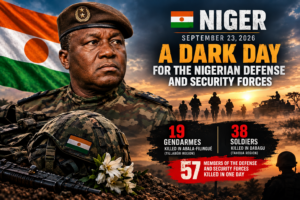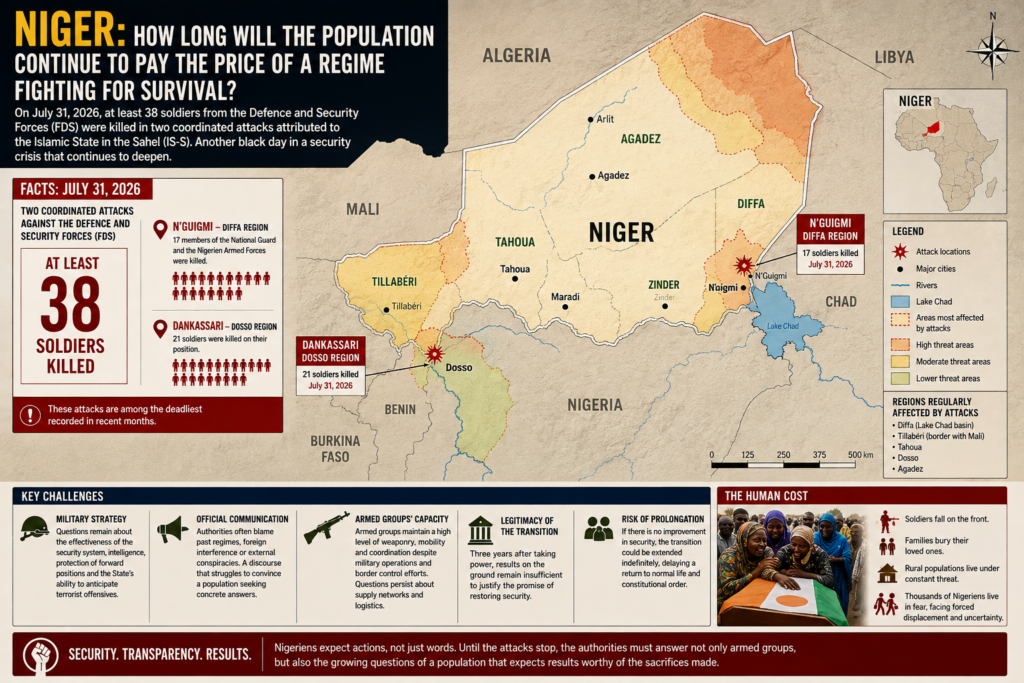
Niger’s recent history was marked by tragedy on July 31, 2026, when coordinated assaults by the Islamic State in the Sahel (IS-Sahel) claimed the lives of at least 38 soldiers from the country’s defense and security forces.
The first attack unfolded in N’Guigmi, a town in the Diffa region, where 17 members of the National Guard and Nigerien Armed Forces perished. Hours later, another deadly strike in Dankassari, within the Dosso region, resulted in 21 more fatalities. These incidents stand among the deadliest in recent months, highlighting the relentless advance of terrorism in the region.
Military losses underscore a widening security void
Beyond the immediate human toll, the attacks reveal deeper operational and strategic vulnerabilities. Questions have emerged about the effectiveness of military intelligence, the security of forward positions, and the state’s ability to preempt terrorist offensives. As assaults multiply, public skepticism toward the current leadership’s approach intensifies.
The military junta, which seized power citing an unmanageable security crisis under civilian rule, pledged to restore stability, regain territorial control, and safeguard civilians. Yet three years into its rule, the situation remains dire, with violence spreading across critical regions such as the Lake Chad basin, Tillabéri, Tahoua, and Dosso.
Political promises clash with battlefield realities
The transitional government’s legitimacy hinges on its ability to deliver security. However, the persistence of large-scale attacks suggests a widening gap between rhetoric and results. Military reorganizations and border control efforts have yet to curb the operational capacity of armed groups, which continue to execute complex, coordinated strikes.
Public frustration grows as officials attribute setbacks to historical legacies, foreign interference, or external influences. While these factors may contribute to the broader conflict, they offer little solace to families mourning lost loved ones or to communities living under constant threat.
Unanswered questions on strategy and accountability
The recurring nature of these attacks raises critical concerns: Are resources being diverted from frontline defense to political consolidation? What measures are being taken to address operational failures? Without concrete actions and transparency, the junta risks eroding public trust and deepening the crisis.
Human cost mounts as terror tightens its grip
The human toll extends far beyond military casualties. Civilians in rural areas face relentless intimidation, forced displacements, and economic hardship. The promise of a return to normalcy remains distant, as armed groups maintain their grip on vast territories, defying repeated military campaigns.
The absence of visible progress on the security front fuels speculation about the sustainability of the current transition. Observers warn that prolonged instability could exacerbate political tensions and delay any meaningful return to constitutional governance.
The road ahead: transparency and action
For the military leadership, the path forward demands more than rhetorical assurances. Nigeriens deserve tangible results—effective intelligence-sharing, robust protection for vulnerable communities, and a clear roadmap to end the crisis. The longer these expectations remain unmet, the heavier the burden on both the state and its people.