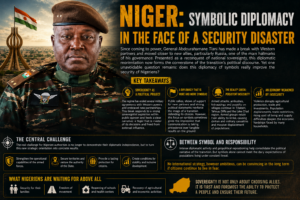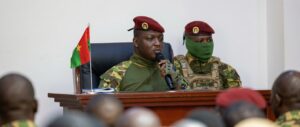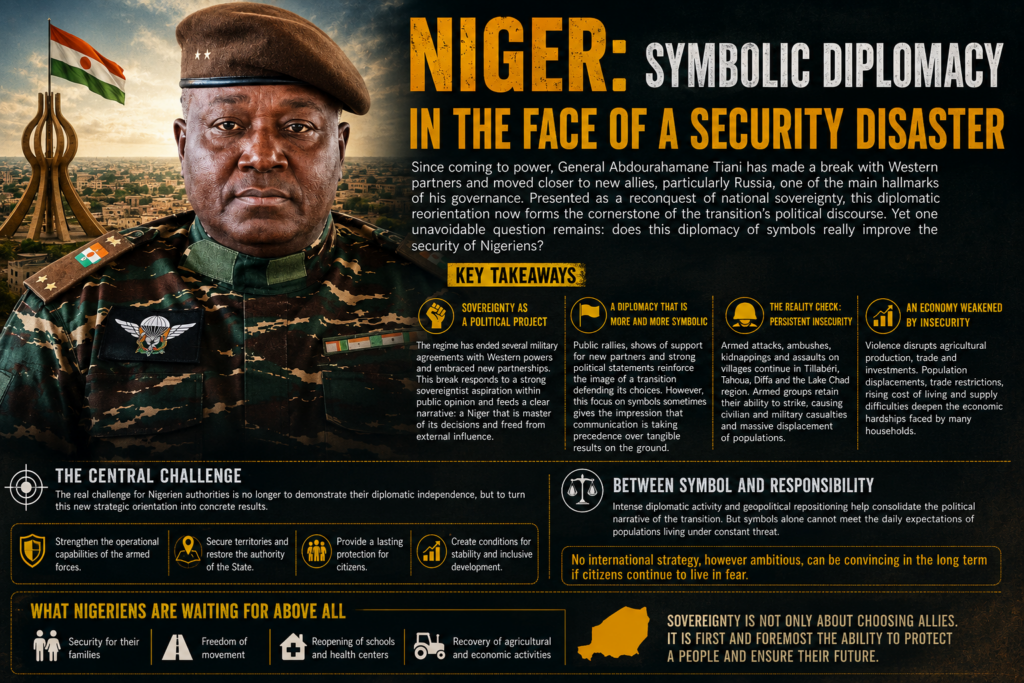
The administration led by General Abdourahamane Tiani has positioned the severance of ties with Western partners and the cultivation of new alliances—particularly with Russia—as defining elements of its governance. This diplomatic pivot, framed as a reclaiming of national sovereignty, now underpins the political narrative of the transitional government. Yet, beneath this display of international resolve, a pressing question emerges: does this symbol-driven diplomacy truly enhance security for the people of Niger?
Sovereignty as a political cornerstone
The decisions made by the National Council for the Safeguarding of the Homeland (CNSP) carry significant political weight. By terminating multiple military cooperation agreements with Western nations and prioritizing alternative partnerships, the regime has addressed a sovereignty-driven sentiment deeply rooted in a segment of public opinion.
At its core, this approach rests on a straightforward political narrative: a Niger that asserts its autonomy, liberates itself from foreign pressures, and independently defines its national priorities. The adherence to the Alliance of Sahel States (AES), the deepening of relations with Moscow, and the numerous initiatives to showcase this geopolitical realignment all reflect an ambition to forge a distinct diplomatic identity.
For supporters of the transition, this departure marks a historic milestone in reclaiming national dignity. Official discourse emphasizes the necessity of breaking away from decades of security and political dependency to construct a model firmly grounded in national interests.
A diplomacy increasingly defined by symbolism
Nevertheless, this strategy occasionally appears to prioritize symbolic gestures over tangible outcomes. Widespread public mobilizations in favor of new partners, rallies endorsing cooperation with Russia, and frequent political declarations dominate the government’s communications.
While these displays of diplomatic alignment bolster the image of a resolute transition, they also raise questions about current priorities. As authorities dedicate substantial resources to international repositioning, citizens continue to demand immediate solutions to pressing concerns: safety, freedom of movement, and the restoration of normalcy.
The reality of enduring insecurity
The security landscape remains the most troubling aspect of the transition’s record. Despite repeated announcements and new military partnerships, armed groups continue to target multiple regions across the country.
Regions such as Tillabéri, Tahoua, Diffa, and parts of the Lake Chad area frequently experience attacks on civilians, defense forces, and public infrastructure. Ambushes, abductions, village raids, and mass displacements perpetuate a climate of persistent insecurity.
Military operations persist, yet armed groups retain significant operational capacity. The toll on civilian and military lives underscores that the security challenge remains far from resolved.
For residents in high-risk zones, geopolitical debates often feel disconnected from their daily realities. Their immediate priorities include safeguarding their families, restoring road safety, reopening schools and health centers, and resuming agricultural and commercial activities.
An economy strained by instability
Beyond human costs, ongoing violence exacts a heavy toll on the national economy. Population displacements disrupt agricultural production, trade remains constrained in several regions, and investments stall amid uncertainty.
The economic disruptions triggered by political upheaval have further exacerbated hardships for many households. In numerous localities, rising living costs, supply shortages, and shrinking economic opportunities intensify feelings of vulnerability.
Without tangible security improvements, the anticipated benefits of new international alliances may remain out of reach for much of the population.
The imperative of turning alliances into tangible results
The central challenge for Nigerien authorities is no longer merely demonstrating diplomatic independence but translating this strategic shift into measurable outcomes. The success of new partnerships will be measured not by official ceremonies or political rhetoric but by their ability to strengthen military operational capabilities, secure territories durably, and restore state authority.
Sovereignty extends beyond alliance choices; it is demonstrated through a state’s capacity to protect its citizens, preserve territorial integrity, and offer stability to its people.
Symbolism versus responsibility
The stark contrast between Niamey’s diplomatic activity and the lived experiences in conflict zones grows more apparent with each passing day. While the narrative of geopolitical repositioning reinforces the transition’s political legitimacy, it cannot, in isolation, fulfill the urgent needs of populations living under constant threat.
History will ultimately assess this military-led transition not solely by the strength of its sovereignty-driven discourse or the scope of its diplomatic choices but by its ability to deliver measurable progress in security, stability, and development. For no international strategy, no matter how ambitious, can endure without first ensuring the safety and protection of its people. The true credibility of any government is built on its capacity to secure peace and safeguard its citizens.