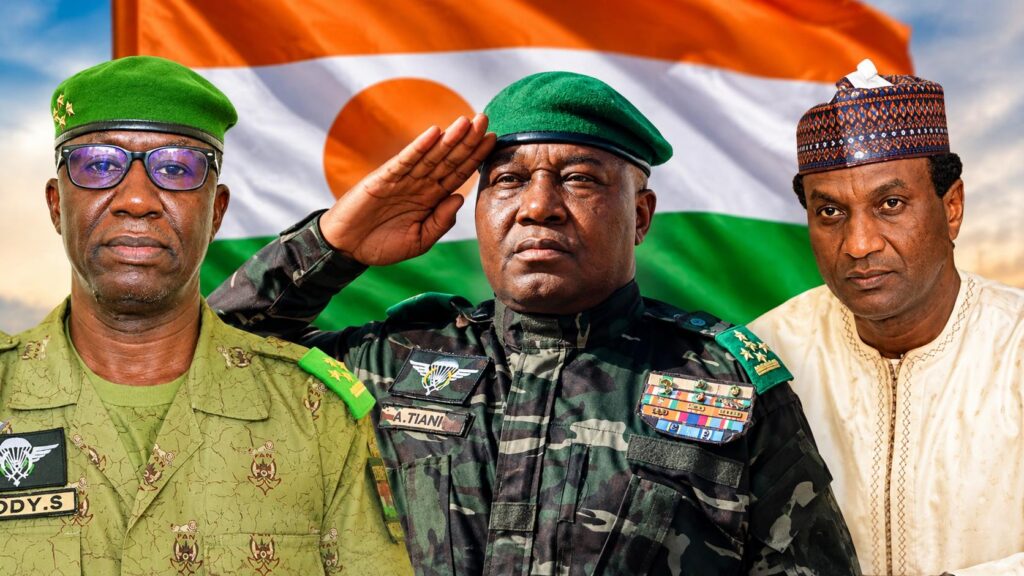
At the highest levels of Niger’s leadership, a fierce struggle has erupted over a military structure whose stakes extend far beyond security alone. At the heart of the matter lies the Commandement des Forces de Protection et de Développement (CFPD), General Salifou Mody, CNSP leader Abdourahamane Tiani, former Finance Minister and Prime Minister Lamine Zeine, and a monthly envelope of 1.8 billion FCFA. This is the moment when a quiet institutional dispute became an open power shift.
The CFPD: a force at the centre of strategic interests
On 9 May 2024, General Abdourahamane Tiani signed decree No. 2024-309/P/CNSP/MDN, establishing the Commandement des Forces de Protection et de Développement. This body was designed to strengthen the protection of Niger’s strategic infrastructure and sites: mining and oil installations, corridors and pipelines. The Ministry of Defence confirmed the creation of this structure, tasked with securing key sites and corridors. At the same time, the recruitment of 10,000 young people in 2024 boosted the ranks of the Nigerien armed forces. The project followed a security rationale and accompanied the growing strength of the military apparatus.
Article 28 and the 1.8 billion figure
Article 28 of the decree sets a Prime Unique d’Astreinte (PUA) of at least 12,000 FCFA per man per day, while requiring a financial contribution from the companies concerned by the security arrangements. For a force of 5,000 men, the amounts break down as follows:
- Per day: 5,000 men × 12,000 FCFA = 60 million FCFA.
- Per month (30 days): 1.8 billion FCFA.
- Per year: 21.9 billion FCFA.
These figures represent the financial reality of the system, reflected in contracts signed with companies, sums paid and personnel deployed. This is the very core of the power struggle within the regime.
Defence versus Finance
General Salifou Mody pushed for the CFPD’s implementation. General Tiani signed the decree under direct pressure from his Defence Minister. After the signature, the CNSP leader ordered Finance Minister Lamine Zeine to block the CFPD’s financial provisions. The result: the structure was created but stripped of the means to operate. General Mody thus suffered a direct political blockage of his project.
The Mody-Zeine dispute
Lamine Zeine became the central point of friction. The Ministry of Finance deliberately blocked the budgetary translation of the military system. By January 2026, Lamine Zeine combined the roles of Prime Minister and Minister of Economy and Finance, while Salifou Mody served as Minister of State for Defence. Mody secured the removal of the Finance portfolio from Zeine, then forced his departure from the Prime Ministership. The conflict over the CFPD destroyed trust among the pillars of power.
Mody takes the Prime Ministership
The reshuffling of power required Zeine’s exit. General Mody took the helm of government and imposed his condition: holding both the Prime Minister and Defence Minister posts. He thus concentrated in his hands the political, military and administrative levers of the regime.
Damolleydi: the second battle
Faced with the CFPD blockage, the regime launched the general mobilisation “Damolleydi” to rally volunteers and existing structures. General Mody took charge of the committee for this mobilisation, sidelining General Mohamed Toumba, Minister of the Interior. Mody found himself at the head of this strategic initiative but deliberately slowed Damolleydi’s implementation. The system lost visibility, supplanted by autonomous local structures.
Control over resources
This affair locks the state apparatus around three axes:
- Command: control over personnel assigned to strategic sites.
- Missions: designating which infrastructure to secure and setting priorities.
- Money: controlling contributing companies and managing the financial flows generated.
Article 28 of the decree governs this financial mechanism of 1.8 billion FCFA per month.
Controlling the system
This 1.8 billion figure is the direct financial stake of the system. It confirms the political dimension of the CFPD, at the crossroads of strategic resources, contributing companies and the chain of command. Beyond the rivalry between Tiani, Mody and Zeine, the winner of this confrontation holds exclusive control over Niger’s men, missions and resources. Behind these personal quarrels, total mastery of the state apparatus is what is being locked down.