From rebellion to reality: the unfulfilled promises of Niger’s new leadership
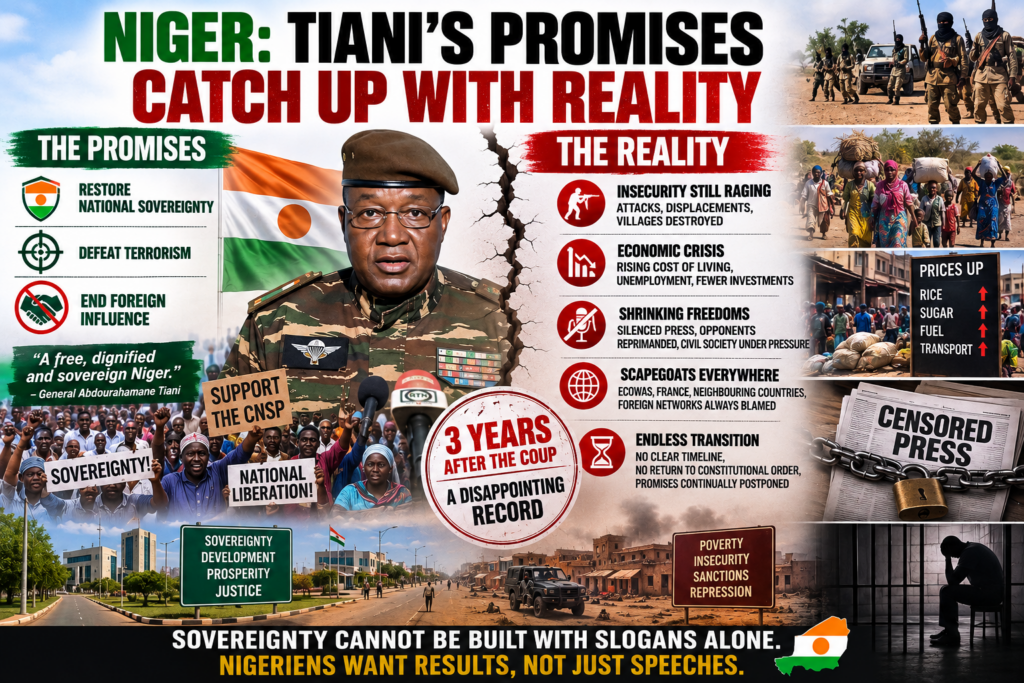
When General Abdourahamane Tiani seized power on July 26, 2023, toppling President Mohamed Bazoum, he framed his coup as a mission anchored in three core promises: restoring national sovereignty, eradicating terrorism, and ending foreign interference in domestic decision-making. This narrative, amplified by state-aligned media and pan-Africanist movements, resonated with a significant portion of the population, weary of chronic insecurity and economic hardship.
Yet three years into his rule, the gap between rhetoric and reality has become impossible to ignore. While official discourse continues to emphasize anti-neocolonialism, the daily concerns of Nigerien citizens remain dominated by worsening security threats, economic precarity, and shrinking civic freedoms.
Patriotic rhetoric as a tool for political legitimacy
The National Council for the Safeguard of the Homeland (CNSP) has built its legitimacy on a straightforward narrative: Niger has regained its sovereignty by severing ties with Western partners. This storyline thrives on a persistent dichotomy between a purportedly patriotic government and foreign actors accused of undermining national interests for decades.
This political strategy serves multiple purposes. It unites segments of public opinion under a shared national identity, deflects internal criticism by framing dissent as complicity with foreign interests, and diverts attention from evaluating actual governance performance.
True sovereignty, however, extends beyond diplomatic ruptures or the withdrawal of foreign forces. It is measured by a state’s ability to protect its people, uphold institutions, preserve fundamental freedoms, and improve living conditions. On these fronts, tangible progress remains scarce.
Political communication that thrives on public disillusionment
The junta has adeptly tapped into deep-seated frustrations rising insecurity, unemployment, inequality, and inflation that had accumulated over years. This fertile ground allowed the new regime to present its takeover as a historic break from the past.
Yet as time has passed, official communication has shifted toward sustaining perpetual patriotic mobilization rather than showcasing verifiable results. Political announcements, regime-sponsored rallies, and denunciations of foreign conspiracies dominate media coverage, while discussions on policy effectiveness remain marginalized.
This shift has redefined the political debate. Accountability for governance actions has given way to loyalty or opposition to the regime, undermining the development of a genuine culture of responsibility.
Security remains the unmet cornerstone
The promise of improved security was the central justification for the overthrow of civilian authorities.
Today, large parts of the country still face relentless attacks by armed groups, mass displacements, and persistent insecurity. Civilians bear the brunt of a conflict that disrupts economic activities, limits access to essential services, and fractures community cohesion.
While the Nigerien military has intensified operations, repeated assaults on military outposts and villages reveal that armed factions retain significant operational capacity. These challenges underscore the limitations of a strategy that relies solely on regime change or shifting international alliances.
The absence of transparent, publicly available indicators to measure progress has only fueled skepticism about the real effectiveness of the current security approach.
Externalizing blame in times of crisis
Faced with mounting difficulties, the regime frequently attributes national crises to external forces. Economic sanctions, former Western partners, neighboring states, and foreign networks are routinely cited as primary culprits behind the country’s struggles.
While regional tensions and international rivalries do influence Sahelian security dynamics, they cannot fully account for Niger’s internal challenges.
The danger of this approach lies in converting every domestic crisis into a diplomatic confrontation, thereby sidelining critical discussions on national responsibility, institutional reform, and governance accountability. In the long run, such a strategy risks weakening the state’s capacity for self-correction and long-term resilience.
An economy under strain
Economic expectations raised by the regime change remain largely unmet. Regional sanctions, reduced foreign investment, trade disruptions, and political uncertainty have impacted key sectors.
Households continue to grapple with soaring living costs, limited access to goods, and scarce employment opportunities. For many citizens, the tangible benefits of political rupture have yet to materialize.
Economic sovereignty, often invoked in official speeches, demands more than rhetoric—it requires sustained improvements in domestic production, infrastructure, public finances, and the business environment. These are long-term challenges that cannot be resolved overnight.
The shrinking space for civic life
Observers are increasingly alarmed by the erosion of public freedoms. Dissenting voices are met with heightened scrutiny, while journalists, civil society actors, and opposition figures operate under intensified state surveillance.
In many military-led systems, the consolidation of power often leads to the gradual dismantling of institutional checks and balances. Niger now faces a similar dilemma: how to maintain national unity amid security threats without sacrificing the pluralism essential to responsible governance?
The lack of a clearly defined political transition roadmap further fuels uncertainty about the longevity of military rule and the prospects for a return to constitutional order.
Between patriotism and the demand for results
Patriotism can be a powerful unifying force. But it cannot indefinitely substitute for tangible outcomes demanded by the people. Sovereignty is not declared it is built through resilient institutions, a robust economy, credible justice, effective security, and transparent governance.
Recent Sahelian history demonstrates that no government military or civilian can sustain legitimacy solely by denouncing external enemies. As time passes, citizens assess their leaders not by their speeches, but by their ability to improve daily life.
For General Abdourahamane Tiani and the CNSP leadership, the true test is no longer proving Niger’s sovereignty to its people. It is demonstrating that this sovereignty delivers real dividends in security, development, justice, and freedom. Without this concrete translation, anti-imperialist rhetoric risks being seen less as a national project and more as a political tool for self-preservation.