Mali offers 2 billion cfa reward for Iyad Ag Ghaly and jihadist leaders
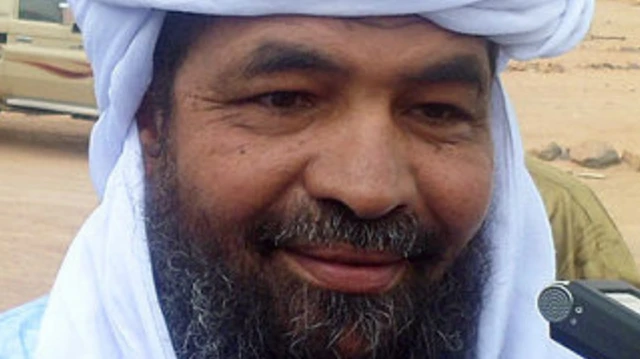
Mali’s transitional authorities have announced a substantial financial reward for information leading to the capture of Iyad Ag Ghaly, the notorious leader of the Jama’at Nusrat al-Islam wal-Muslimin (JNIM), and six of his associates. The announcement follows coordinated attacks in Kidal and Kati that left the country’s Defense Minister dead and exposed vulnerabilities in national security.
In a televised statement, the Malian Ministry of Security and Civil Protection revealed the rewards, ranging from 500 million to 2 billion West African CFA francs, depending on the individual’s role in the recent unrest. The move underscores the government’s intensified efforts to combat terrorism and restore stability in a region plagued by insecurity.
Government’s formal announcement
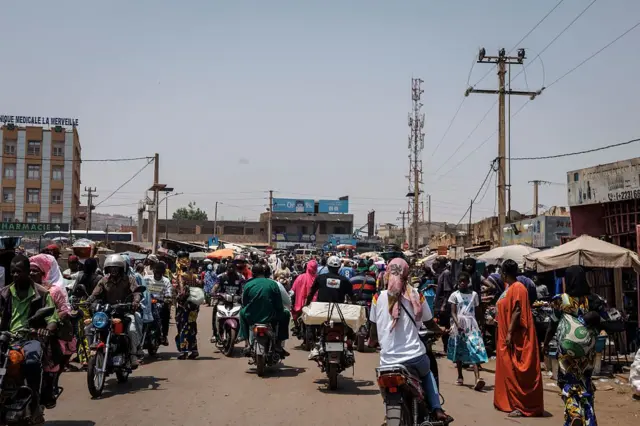
In an official communiqué broadcast on national television, the Ministry stated: “In the ongoing fight against terrorism and to safeguard national security, the Government of the Republic of Mali is offering financial rewards to individuals who provide reliable and actionable information leading to the arrest or neutralization of the following individuals.”
The highest reward of 2 billion CFA francs is earmarked for Iyad Ag Ghaly, the emir of the JNIM, a coalition of militant groups operating across the Sahel. The Ministry also named Amadou Koufa, leader of the Macina Katiba, and Abdoulaye Mohamed (alias Habib), both of the same faction, each carrying a 1.5 billion CFA franc bounty.
Among other high-value targets is Algabas Ag Intallah, a key political and military figure of the Azawad Liberation Front (FLA), whose capture is valued at 1 billion CFA francs. Three other FLA leaders—Ghita, Bilal Chérif, and Abderrahmane Al Banna—are each sought for 500 million CFA francs.
The announcement comes two months after the deadly April 25 coordinated assaults on Kidal and Kati, which resulted in significant casualties, including the loss of the Defense Minister. Authorities have linked these attacks to both jihadist factions and separatist groups, intensifying the urgency of their counterterrorism measures.
Profile of Iyad Ag Ghaly: from rebel to jihadist emir
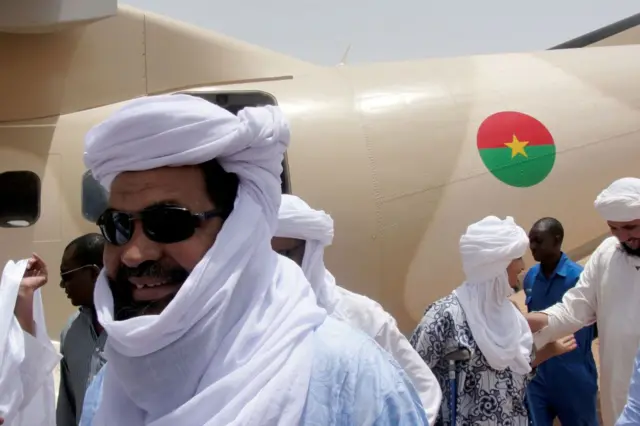
Born in 1958 in Boghassa, in the Kidal region of northern Mali, Iyad Ag Ghaly has evolved from a Tuareg rebel leader to one of the most influential jihadist figures in the Sahel. His journey reflects the complex interplay of politics, ethnicity, and extremism that has shaped Mali’s decades-long conflict.
In the 1970s, Ghaly fled to Libya, where he joined the forces of Colonel Muammar Gaddafi alongside other young Tuareg men. His military experience expanded during this period as he participated in conflicts in Lebanon and Chad. Upon returning to Mali in the early 1990s, he founded the Popular Movement for the Liberation of Azawad (MPLA) and launched a Tuareg rebellion against the Malian state.
His early militant career included leadership roles in the Azawad Popular Movement (MPA), which fought government forces before signing a peace agreement in 1992. However, Ghaly’s ambitions soon shifted toward Islamist extremism. By 2007, he had aligned with the Salafist Group for Preaching and Combat (GSPC), an Al-Qaeda affiliate that later became Al-Qaeda in the Islamic Maghreb (AQIM).
In 2012, Ghaly established Ansar Dine, a Salafist jihadist group, and joined forces with AQIM to seize control of northern Mali. His influence grew further in 2017 when he became the emir of the Group for the Support of Islam and Muslims (JNIM), a merger of several Malian jihadist factions that pledged allegiance to both AQIM and Al-Qaeda.
According to regional security analysts, Ghaly has emerged as “the most wanted man in the Sahel” and a critical threat to Mali’s government. His strategic shift in recent months has alarmed authorities; rather than relying solely on direct military confrontation, he has adopted an economic blockade tactic. By targeting key infrastructure such as roads and power lines, he aims to cripple the capital, Bamako, by cutting off essential supplies of food, fuel, and electricity. Analysts suggest his ultimate goal is not to govern Mali but to destabilize the regime through relentless pressure on daily life.
“His strategy is to isolate the current government and force its collapse from within,” noted a regional security think tank. “The threat now transcends the battlefield, directly impacting the lives of ordinary Malians. This forces the government to adopt urgent measures to protect the country’s core.”
Ghaly’s actions have not gone unnoticed internationally. The International Criminal Court (ICC) issued a warrant for his arrest years ago, charging him with crimes against humanity and war crimes committed between 2012 and 2013. As the leader of the JNIM, he continues to orchestrate attacks across Mali, Niger, and Burkina Faso, collectively known as the Alliance of Sahel States (AES), spreading terror and instability across the region.