JNIM’s growing grip on Mali: the silent takeover
Recent waves of attacks claimed by the Group for the Support of Islam and Muslims (JNIM), an Al-Qaïda affiliate, are exposing Bamako’s vulnerability as the group tightens its control across Mali. From ambushes targeting government troops to coordinated assaults on military outposts and systematic disruption of key supply routes, the jihadist organization is deepening its operational reach with alarming efficiency.
 Iyad Ag Ghali, JNIM leader
The Sahel’s silent metastasis
What began as a localized insurgency in Mali has metastasized into a regional crisis that now threatens neighboring nations. The JNIM’s expansion isn’t confined to Mali’s borders—its influence is spreading across the Sahel, creating a domino effect of instability. Weak governance structures and worsening economic conditions across West Africa are creating fertile ground for further jihadist encroachment.
More than just violence: building parallel systems
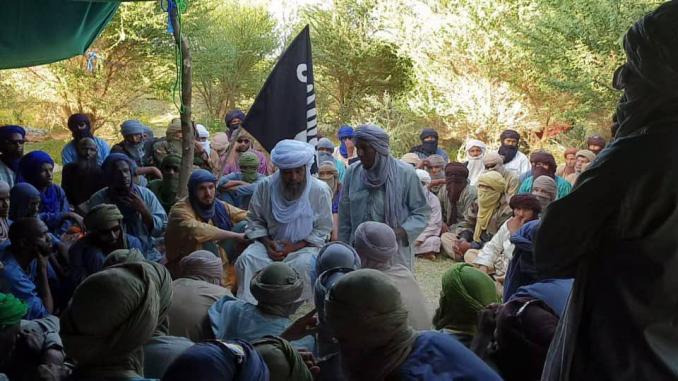
The JNIM’s strategy goes beyond military confrontation. Reports from central Mali confirm five villages in the Bandiagara region were attacked on May 21, 2026, with the group imposing its own systems of governance where state authority has collapsed. This approach mirrors tactics used by other extremist groups worldwide—exploiting local grievances, mediating community disputes and establishing alternative taxation systems to fund their operations.
This dual approach of armed violence and administrative takeover presents a critical challenge: military operations alone cannot restore stability when the underlying governance vacuum remains unaddressed. The pattern is clear—clear an area today, and by tomorrow, the JNIM has reasserted control through community networks and shadow governance.
Bamako’s security pivot and its consequences
Since international partners reduced their military presence and Mali pivoted toward Russian security partnerships, Bamako has emphasized military sovereignty. While the transition government frames this as liberation from Western dependence, the security reality tells a different story. Violence persists, armed groups remain highly mobile, and reports of human rights violations involving both Malian forces and allied Russian groups have surfaced, further complicating the crisis.
The hardening of political positions leaves little room for compromise or mediation. As international actors jockey for influence—with Russia, Turkey, the UAE, Western powers and regional states all vying for position—the jihadist groups exploit these fractures to deepen their entrenchment.
What comes next? The looming question of Mali’s future
With the Africa Corps mercenary support potentially scaling back operations, the critical question emerges: how will Bamako respond when external military backing diminishes? The current situation reveals a fragile equilibrium where neither the state nor jihadist factions fully control the territory. The real test will be whether Mali can rebuild governance structures before the JNIM’s parallel systems become the de facto order in vulnerable regions.