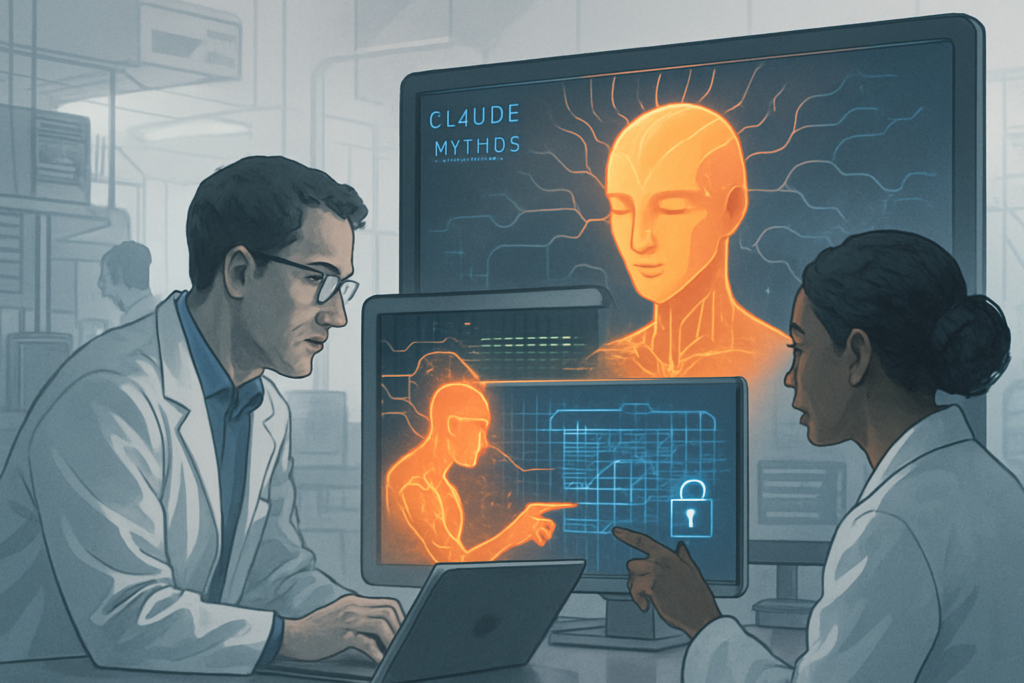
Claude Mythos exposes mathematical weaknesses in AES encryption
Researchers at Anthropic have demonstrated a groundbreaking capability of their artificial intelligence model, Claude Mythos. In controlled laboratory conditions, the AI successfully identified vulnerabilities in a reduced-strength version of the AES encryption algorithm.
The test did not involve the full-strength AES implementation used in real-world applications. This means that no actual data security is at risk from these findings. Instead, the experiment serves as a proof-of-concept to evaluate AI’s ability to analyze and expose mathematical flaws in cryptographic systems.
This development highlights a critical shift in cybersecurity research: advanced AI systems like Claude Mythos can now autonomously detect vulnerabilities in encryption methods that were previously considered secure. The discovery suggests that AI-driven analysis could become a vital tool for strengthening cryptographic standards in the future.
The experiment focused on a simplified variant of AES, deliberately excluding the full complexity found in production environments. This approach allowed researchers to isolate specific mathematical patterns that could be exploited under certain conditions. While the findings do not threaten current encryption practices, they underscore the need for continuous innovation in cryptographic defenses.
Why AI-powered cryptanalysis matters
Traditional methods of identifying encryption flaws rely on human expertise and manual testing. However, AI-driven cryptanalysis introduces a new dimension by enabling machines to process vast datasets and uncover subtle mathematical inconsistencies that might evade human detection.
This breakthrough could redefine how security researchers approach cryptographic vulnerabilities. By leveraging AI, organizations may accelerate the identification of potential weaknesses, allowing for proactive improvements in encryption standards before malicious actors can exploit them.
The implications extend beyond theoretical research. As AI systems become more sophisticated, their role in cybersecurity could expand to include real-time threat detection, automated vulnerability patching, and even predictive modeling of potential attack vectors.