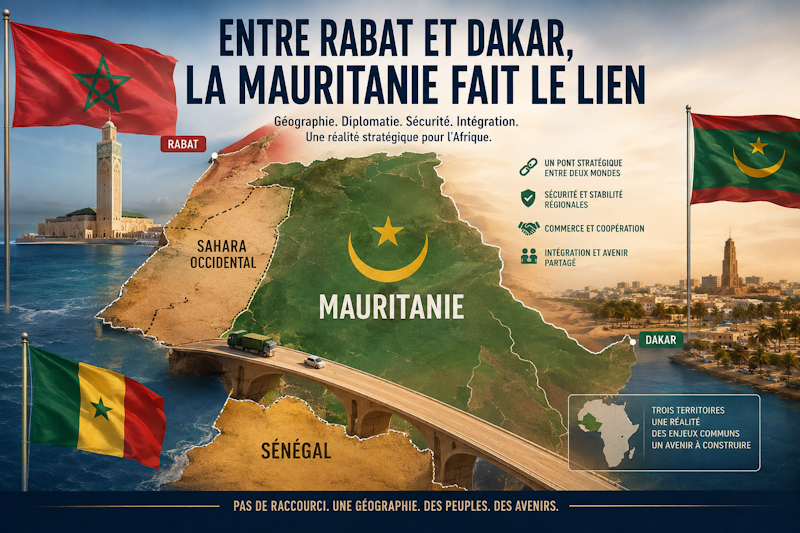

When examining the relationship between Morocco and Senegal, one cannot ignore the pivotal role of the Western Sahara and, above all, the Mauritania—a fact underscored by Mauritanian journalist Ahmed Ould Bettar.
The overlooked middle ground: Mauritania’s strategic importance
Geography often simplifies complex realities, but in this case, it reveals an undeniable truth: there is no direct passage between Morocco and Senegal. The Western Sahara stands in the way, and at the heart of this debate lies Mauritania. While some may dismiss it as a mere transit zone, the nation is far more than a stretch of desert—it is a sovereign state, a diplomatic heavyweight, and a critical link between North and West Africa.
Its significance extends beyond borders. Mauritania serves as a linchpin for regional security, economic exchange, and integration. To overlook its presence is to ignore a fundamental piece of the puzzle that connects the Maghreb and Sub-Saharan Africa. The country’s role is not just geographical; it is geopolitical, economic, and cultural.
Why geographical shortcuts miss the mark in geopolitics
The temptation to take shortcuts in analysis is strong, but in matters of international relations, such oversights can distort reality. The Western Sahara, a territory mired in international dispute, cannot be bypassed when discussing Morocco and Senegal. Similarly, the Islamic Republic of Mauritania, with its strategic position, cannot be reduced to a footnote.
Diplomatic narratives that sidestep these realities risk painting an incomplete picture of West African and Maghreb dynamics. The Mauritanian state, recognized globally, plays an indispensable role in fostering stability and cooperation across the Sahel. Ignoring its contributions—or worse, reducing it to a mere geographical obstacle—undermines the complexity of the region’s challenges and opportunities.
The high stakes of oversimplification
At its core, geopolitics demands precision. The space between Rabat and Dakar is not a blank canvas but a landscape shaped by history, sovereignty, and competing interests. The Western Sahara remains a flashpoint, while Mauritania acts as a stabilizing force. To dismiss either is to risk misjudging the very forces that define North and West Africa today.
In the end, the lesson is clear: when it comes to geopolitics, shortcuts are not just unwise—they are dangerous.