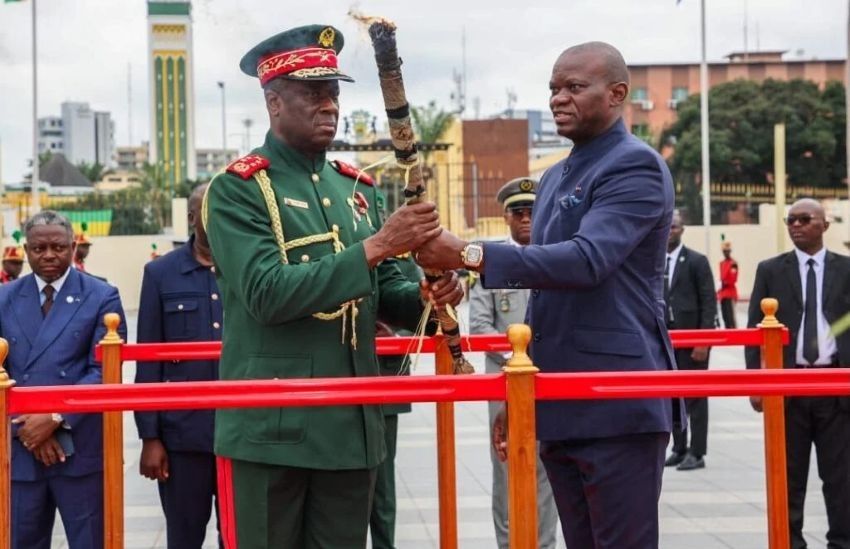
Libreville — The message emanating from Libreville now signifies more than mere solidarity between two African nations. By hosting Guinea-Bissau during the 66th anniversary celebrations of Gabonese independence, Brice Clotaire Oligui Nguema unequivocally reaffirmed his dedication to supporting the ongoing transition process in Bissau, initiated in 2025. His central belief remains firm: a transition only achieves lasting legitimacy if it culminates in a credible return to constitutional order within its announced timeframe.
The reception extended to the Bissau-Guinean leader, complete with military honors and a parade featuring the Republican Guard, carried profound symbolic weight. The ceremonial handover of the flame to Guinea-Bissau’s President of the Transition further solidified Gabon’s endorsement of the current political evolution.
Yet, beyond the established protocol, Libreville actively seeks to highlight a specific political methodology.
From Libreville to Bissau: the Gabonese experience as a benchmark
During the working session that brought together delegations from both countries, Oligui Nguema underscored three principles he deems crucial for a successful transition: the chosen method, adherence to republican discipline, and strict respect for the established timeline.
Gabon intends to leverage its own recent journey to assist another nation grappling with the intricate challenge of exiting a transitional period. For Libreville, the objective should not be to indefinitely prolong an exceptional phase, but rather to utilize it to re-establish the conditions for a sustained institutional legitimacy.
This approach places particular importance on Guinea-Bissau’s electoral calendar. A constitutional referendum is slated for the coming months, preceding a presidential election scheduled for December 6, 2026. For the Gabonese president, the observance of these deadlines will serve as a critical indicator of the process’s credibility.
However, the true test will lie in the quality of the ballot. An election alone is insufficient to restore trust; it must be free, transparent, inclusive, and sufficiently credible for its outcomes to be accepted by all major stakeholders.
It is precisely on this foundation that the success of the Bissau-Guinean transition will be judged. Its successful conclusion could significantly contribute to restoring international confidence, securing the institutional environment, and fostering the necessary conditions for economic development and investment.
A cooperation aiming beyond politics
The discussions between Libreville and Bissau were not exclusively confined to institutional matters. General Division Horta N’tam expressed gratitude for the warm welcome extended to his delegation and recalled the historical ties binding the two peoples.
Both nations now aspire to broaden their collaboration into sectors capable of yielding tangible results. Identified areas include biodiversity preservation, the fight against climate change, and professional training for youth.
This strategic direction is vital. Political transitions cannot generate lasting stability unless accompanied by discernible economic and social improvements for the populace. Institutional stability must create an environment conducive to work, investment, youth development, and the valorization of national resources.
The two parties also agreed to bolster their inter-governmental consultation mechanisms. The upcoming challenge will be to translate the political rapport demonstrated in Libreville into concrete programs, complete with clear objectives, secured funding, and measurable outcomes.
Gabon’s evolving doctrine on African transitions
Through its unwavering support for Bissau, Oligui Nguema also seeks to position Gabon within the continental discourse concerning power shifts in Africa. The continent continues to face a delicate dilemma: how to support transitions without normalizing their indefinite prolongation and without undermining the ultimate goal of returning to legitimate civilian institutions?
The response championed by Libreville appears to be crystallizing around a straightforward principle: a transition must be a passage, never a final destination.
To maintain credibility, it must possess a clear roadmap, defined deadlines, and an obligation to deliver results. Furthermore, it must prepare the groundwork for open political competition, rather than merely orchestrating the succession of an exceptional power.
Gabon thus intends to capitalize on its recent national experience to advocate for an approach rooted in dialogue, institutional discipline, and the fulfillment of commitments.
For Guinea-Bissau, the critical date of December 6, 2026, could prove to be the decisive trial for this strategy. For Gabon, its accompanying role presents an opportunity to demonstrate that a national transition experience can effectively become a tool for continental cooperation.
Libreville, therefore, offers more than just support to Bissau. It champions a vision of African transition founded on an essential idea: exceptional power can indeed open a new chapter, but only an orderly exit towards credible institutions can genuinely bring it to a close.