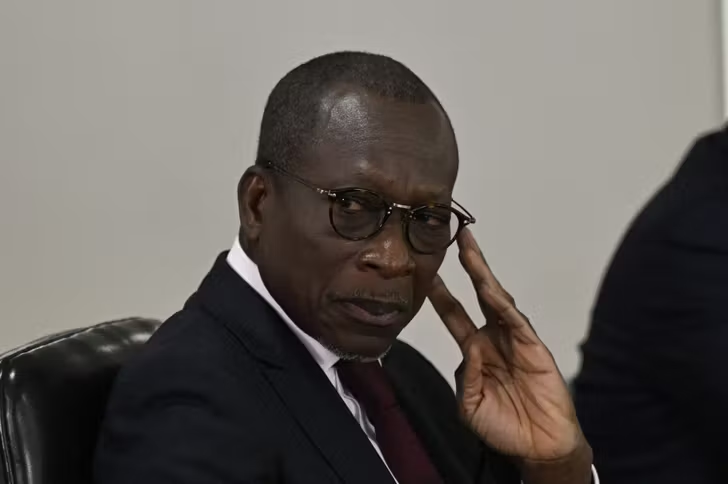
Confusion gripped the streets of Bénin this Sunday morning. The national government announced that it successfully thwarted an attempted coup in Cotonou. The crisis began when a group of soldiers appeared on state television, claiming to have stripped President Patrice Talon of his executive powers.
Patrice Talon is reportedly safe, according to his inner circle. He is currently scheduled to step down following the presidential elections next April, concluding two terms leading this West African nation. While the country has maintained consistent economic progress, it has recently struggled with escalating jihadist threats in its northern territories.
By midday Sunday, the atmosphere in Cotonou remained tense and uncertain. Witnesses reported hearing gunfire in the economic hub, and military forces restricted access to the presidential palace. Despite the heavy security presence in specific sectors, other parts of the city saw residents continuing their daily routines. Here are the primary details of the situation.
The rise of the “Military Committee for Refoundation”
During the early hours of Sunday, eight soldiers armed with assault rifles and wearing distinctive berets seized the airwaves. Calling themselves the “Military Committee for Refoundation” (CMR), they announced the dismissal of President Patrice Talon.
The group named a lieutenant-colonel as the head of the CMR. They justified their actions by citing a “continuous decline in security” in northern Bénin, the alleged abandonment of fallen soldiers and their grieving families, and what they described as “unfair promotions” within the military ranks.
Furthermore, the mutineers criticized the government for what they called a “disguised erosion of fundamental freedoms” and presented a list of social demands.
Presidential safety and military blockades
The broader Béninois military did not align with the mutineers. Alassane Seidou, the Minister of the Interior, later appeared on television to confirm that the armed forces remained loyal to the republic. He stated that their swift reaction allowed the government to maintain control and neutralize the threat. These reassurances came even as reports of gunfire circulated in Cotonou.
Sources close to President Talon informed the press that the head of state was out of harm’s way and that regular troops were re-establishing order. One source described the group as a small faction that only managed to seize the television station, asserting that the city and the wider country were now secure.
Currently, military personnel continue to block access to the national television headquarters and the presidency. Several other key areas, including the Sofitel luxury hotel and districts housing international organizations, remain cordoned off.
Ongoing security operations
A military official confirmed that the situation is “under control,” noting that the rebels failed to capture either the President’s private residence or the official presidential palace. The source indicated that security forces are conducting a “cleanup” operation to fully restore order.
The Economic Community of West African States (ECOWAS) issued a statement strongly condemning the unconstitutional move, labeling it a subversion of the people’s will. The regional body pledged to support the Béninois government and its citizens through all necessary channels.
Similarly, the African Union (AU) voiced its unequivocal condemnation of the coup attempt, demanding that the soldiers return to their barracks immediately. In a post on X, the AU urged all participants in the uprising to cease illegal activities and resume their professional duties without delay.
Talon and the shift toward authority
The political timeline of Bénin has been marked by various power struggles and coup attempts. Patrice Talon, who took office in 2016, is expected to finish his second and final constitutional term in 2026.
The upcoming political landscape sees the main opposition party sidelined, leaving the race primarily between the ruling party and a candidate described as a “moderate” opponent.
While Patrice Talon is credited with driving economic growth, he faces frequent criticism for an alleged authoritarian shift in a nation once celebrated as a beacon of democracy in the region.
This incident follows a series of recent coups across West Africa, including takeovers in Mali, Burkina Faso, Niger, Guinée, and Guinée-Bissau.