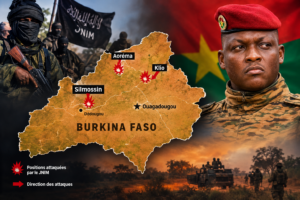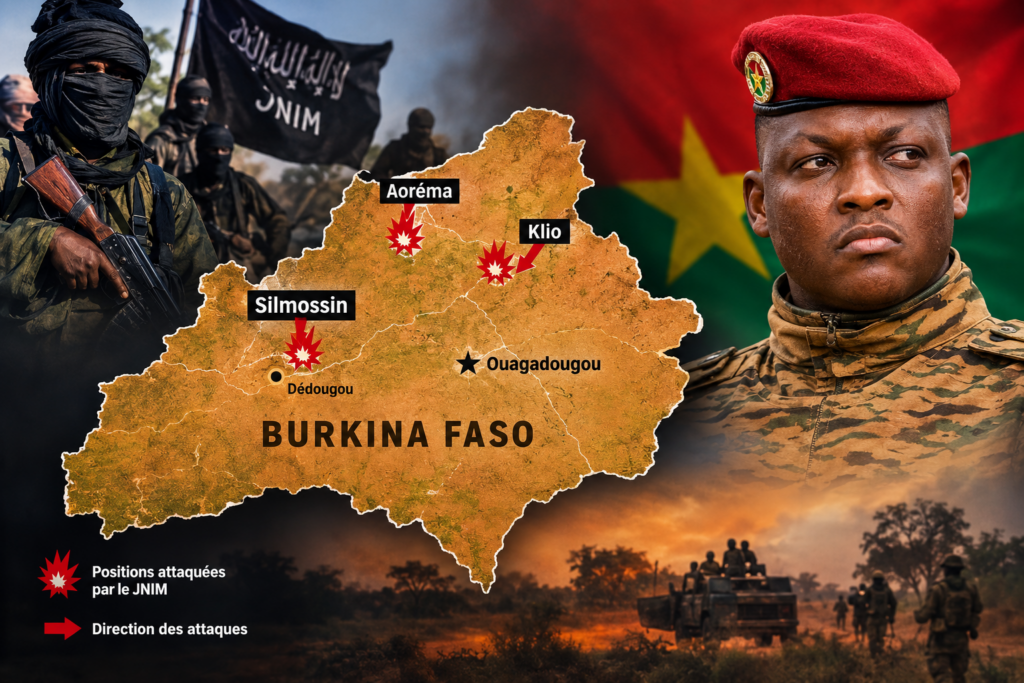
On the evening of Friday, September 25, 2026, the JNIM declared it had seized full control of several military positions held by Burkinabè militias in Silmossin, near the town of Dédougou. The announcement arrived amid a steady stream of similar claims by the jihadist group against Burkinabè forces and the Volunteers for the Defense of the Homeland (VDP).
A single day, multiple claims across the country
That same Friday, the JNIM also asserted it had overrun two positions used by the Burkinabè army and the VDP in Aoréma and Klio, both in the country’s north.
Beyond the accuracy of any individual claim, the sheer repetition of these announcements forces a central question into the open: how effective is the security strategy really, since Captain Ibrahim Traoré took power?
From doctrine to delivery
For years, the Burkinabè authorities have framed territorial reconquest, the strengthening of national forces, and the mobilization of the VDP as the pillars of a new security doctrine. But a military strategy cannot be judged solely by the number of soldiers deployed, operations announced, or areas declared recaptured. What matters most is whether the state can hold its positions over time, keep civilians safe, secure road corridors, and prevent armed groups from returning to zones that were retaken.
It is precisely on that durability that the difficulties persist.
The VDP: expanded reach, exposed fighters
The heavy reliance on the VDP has broadened the defense apparatus, but it also places non-professional fighters in particularly vulnerable positions. Analyses of JNIM operations highlight factors such as intelligence, mobility, logistics, road surveillance, coordination between units, and above all, the capacity to hold forward positions over the long term.
The problem therefore runs deeper than any single battle won or lost. Retaking a position does not automatically restore the state’s authority in a lasting way. A genuinely secure area must allow administrations to function, schools to reopen, markets to resume activity, farmers to return to their fields, and displaced populations to come home.
That is the ground on which the Traoré regime’s security record deserves to be examined far more rigorously.
A political narrative versus village-level reality
Since taking power, Captain Ibrahim Traoré has made sovereignty, popular mobilization, and military reconquest central elements of his political message. Official communications repeatedly stress the successes of national forces. Yet when armed groups continue to claim attacks on military positions or VDP units, those announcements must be weighed against what can actually be observed on the ground.
On September 25, Burkina Faso’s foreign minister himself acknowledged the need to learn lessons from what “has not worked so far” and stressed the importance of preventing the recruitment of young people by terrorist groups.
That statement matters: it shows that even within official circles, a purely military response is understood to be insufficient.
An adaptable insurgency
Burkina Faso is confronting a particularly adaptable insurgency. The JNIM has developed capabilities in mobility, intelligence, financing, and the use of new technologies, while its operations continue to pressure security forces and civilian populations alike. ACLED has highlighted the evolution of jihadist tactics, the growing use of drones, and the difficulties Sahelian states face in permanently preventing armed groups from re-entering certain areas.
The real challenge for Ibrahim Traoré is therefore no longer simply to produce a narrative of victory. It is to demonstrate, with figures and results, that the strategy launched in 2022 is actually reducing violence over the long term and restoring state authority.
Political communication can present progress. The field imposes a different demand: lasting security for the population.
What the Silmossin claims could signal
If the JNIM’s claims in Silmossin were confirmed, they would mark yet another sign of vulnerability among forward positions. But even before any confirmation, the multiplication of claims against Burkinabè positions raises a legitimate question: why do certain areas remain so hard to secure despite increases in troop numbers, equipment, and resources devoted to counterterrorism?
That is where the real assessment of Ibrahim Traoré’s security record lies.
The debate should not be confined to slogans, images of military operations, or declarations of victory. It must focus on verifiable indicators: areas durably secured, attacks on civilians, military losses, freedom of movement, the return of displaced persons, the functioning of public services, and the ability of national forces to hold recaptured positions.
Without transparent data to measure these elements, the gap between the official narrative and information from the field will continue to fuel questions.
And in a war against armed groups, it is not slogans that settle the debate: it is lasting results on the ground.