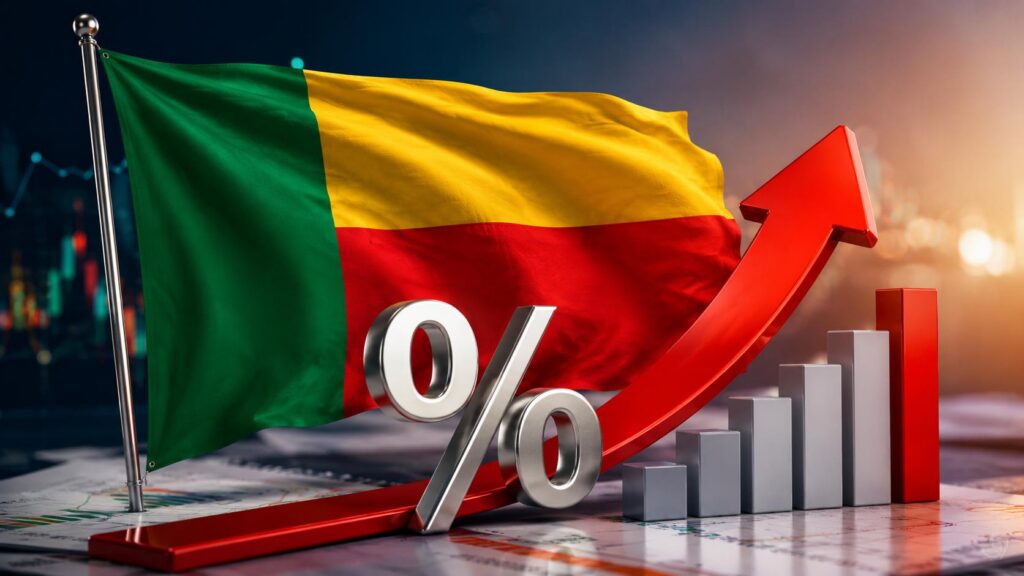
Amidst a turbulent global landscape marked by geopolitical tensions and market instability, Benin continues to demonstrate an impressive economic trajectory. The country’s GDP surged by 8.1% in 2025, with projections maintaining growth above 7% through 2027. This remarkable performance is fueled by the expansion of the Glo-Djigbé Industrial Zone (GDIZ), port infrastructure modernization, and strict fiscal discipline, though significant social and security challenges persist.
Navigating global headwinds with remarkable economic resilience
As the global economy struggles to regain stability amidst supply chain disruptions and financial uncertainties, Benin stands out as a beacon of resilience. Following a 7.5% GDP growth in 2024, the country accelerated to an 8.1% expansion in 2025, one of the highest performances on the continent.
This exceptional growth isn’t accidental. The foundations rest on strengthened macroeconomic fundamentals and ongoing structural reforms. A strategy focused on diversification and local transformation is now bearing fruit, enabling the country to better absorb external shocks.
Sectoral contributions: a broad-based economic surge
Industrial and infrastructure momentum
The industrial sector recorded a remarkable 9.8% growth, driven by major sanitation projects, road infrastructure upgrades, and port modernization. The GDIZ serves as a catalyst for manufacturing industries, while extractive activities surged due to increased quarry operations supplying local cement plants and new tile manufacturing lines.
Thriving services and digital transformation
The tertiary sector expanded by 8.5%, buoyed by digital services growth, robust international trade, and the strategic role of the Port of Cotonou. Logistics and transportation continue to bolster regional trade flows.
Resilient agriculture and livestock
Agriculture maintained steady progress with a 5.7% increase. Livestock production notably rose by 8.8%, supported by favorable agricultural conditions and targeted investments in local productivity. Investment emerged as the primary growth driver, climbing 10.7% in 2025, complemented by a 7.3% rise in household consumption.
Monetary stability and fiscal discipline: safeguarding economic gains
Inflation remains under control
In a global environment often plagued by inflationary pressures, Benin has successfully preserved household purchasing power. Inflation stood at just 1.1% in 2025, well below the 3% UEMOA community benchmark. This achievement stems from stable fuel supply costs from neighboring Nigeria and abundant local harvests that curbed food price inflation.
Strong financial sector and fiscal consolidation
The banking sector remains robust, with an 8.8% increase in economic credit and a 9.2% rise in banking assets, maintaining a solvency ratio comfortably above regulatory requirements. On the fiscal front, the government maintained its austerity measures, with tax revenues rising from 13.3% to 13.9% of GDP while keeping public spending at 18.7% of GDP. This discipline reduced the budget deficit from 3% to 2.8% of GDP. While Benin’s over-indebtedness risk remains moderate, the institution warns of the rising cost of international commercial debt servicing.
Trade expansion: shifting toward processed exports
Benin is gradually transitioning from a transit economy to one focused on exporting processed goods. Through the GDIZ, cotton, soybeans, and cashew nuts are no longer merely exported raw but transformed locally into textiles and food products. Exports now account for 23% of GDP, up from 21.8% previously, helping reduce the current account deficit to 5.8% of GDP. Within the UEMOA zone, foreign exchange reserves now cover 7.6 months of imports, providing reassuring trade stability.
Looking ahead, growth is expected to remain stable at 7% in 2026 and 7.1% in 2027. This optimism is rooted in political stability, expanded Cotonou infrastructure, and new extraction projects like the Sèmè oil field and Perma gold mine.
The social imperative: harnessing demographic dividends
Despite these strong macroeconomic indicators and a 5.6% rise in real GDP per capita in 2025, tangible improvements in living standards remain limited. While the GDIZ has created 25,000 direct jobs, over 90% of Beninese workers still operate in the informal sector. This structural imbalance constrains productivity gains and hinders rapid poverty reduction.
To address this gap, intensified investments in vocational training are essential to align educational offerings with emerging industry needs, while fostering sustainable formal employment opportunities to fully capitalize on the demographic dividend.
Navigating risks: strategic priorities for sustainable growth
Despite this promising trajectory, several risks could derail projections. Externally, escalating tensions in the Middle East and prolonged oil price increases pose real threats. Regionally, security uncertainties in northern Benin and economic dependence on Nigeria’s trade policies remain concerns, alongside climate-related agricultural risks.
To secure this growth, maintaining fiscal discipline while accelerating energy infrastructure projects like the Dogo-Bis hydroelectric plant is critical. This will enhance national energy autonomy, reduce production costs for GDIZ factories, and strengthen the country’s overall competitiveness.
Benin has emerged as a model of macroeconomic resilience in West Africa. By leveraging local industrialization, fiscal rigor, and port infrastructure development, the country is poised for growth exceeding 7% through 2027. However, the ultimate measure of success will be its ability to reduce informality, secure its borders, and translate this prosperity into concrete opportunities for its youth.