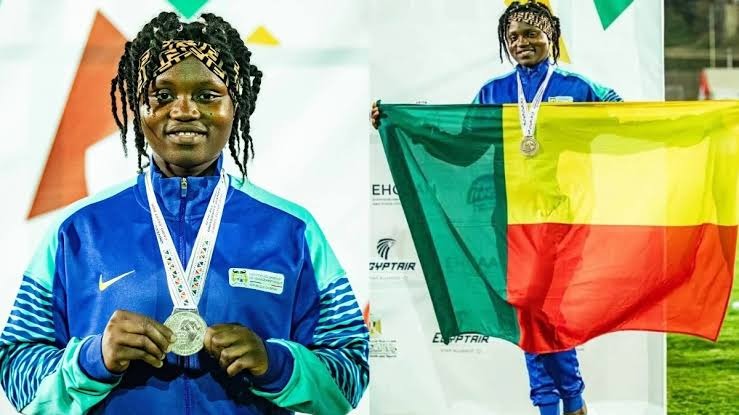
The 12th African University Games in Cairo ended with an unexpected highlight for Benin—and it came from an athlete who had quietly been refining her craft behind the scenes. Brigitte Tchede, a rising star from Porto-Novo, didn’t just make her mark on the competition—she redefined what was possible for Beninese athletics in continental university sports.
With two medals in two different events, Tchede single-handedly secured Benin’s first-ever podium finishes at this edition of the Games. But the true story lies not just in the trophies on her shelf, but in the technical breakthroughs and strategic work that made her double success possible.
The mechanics of progress: how a 2.71-meter jump redefined a national mark
Brigitte Tchede’s first medal came in the women’s discus throw on September 13, where she landed a silver medal with a throw of 47.08 meters. That figure wasn’t just a victory—it was a personal record, shattering her previous best of 44.37 meters set just months earlier in Accra during the African Athletics Championships.
The leap of 2.71 meters in a single season is not just impressive—it’s statistically rare in discus throw. This kind of performance jump typically requires months of targeted technical work: refined footwork, improved rotational force, and optimized release timing. Coaches and analysts at the time noted Tchede’s focus on biomechanical efficiency in training, emphasizing core stability and lower-body coordination—elements that rarely get the public spotlight but are essential in a sport where fractions of a meter decide podiums.
The role of data in her rise
Behind the scenes, Tchede’s support team had integrated performance analytics into her training regimen. Using high-speed video analysis and force plate measurements, they identified inefficiencies in her throw technique, particularly in the transition from rotational speed to final release. Adjustments in body positioning and timing enabled her to generate more forward momentum without losing accuracy—leading directly to the 2.71-meter surge.
This wasn’t luck. It was preparation meeting opportunity—a strategy visible only to those who understood the inner workings of elite training.
Dual discipline dominance: the unseen versatility of a Beninese champion
What many observers missed was that Tchede’s Cairo performance wasn’t limited to the discus. She also secured a second medal in an unspecified second discipline—marking another first for Benin in African university sports. That dual-podium result is no accident; it reflects a multifaceted athletic development program that prioritizes versatility over specialization at an early stage.
According to team officials, Tchede trains across multiple throwing events—shot put and discus—using overlapping techniques that share common biomechanical foundations. This cross-training approach allows athletes to build overall power and rotational stability while adapting to different equipment dynamics. In a sport like athletics, where transitions between events are rare at the elite level, such dual success is a strategic differentiator.
From Accra to Cairo: how two continental events revealed a pattern
The journey from her 44.37-meter throw in Accra to the 47.08-meter effort in Cairo wasn’t a fluke—it followed a clear trajectory. In-between, Tchede participated in national qualifiers and regional trials, each time fine-tuning mechanics under competitive conditions. Her coaches emphasized a “progressive overload” training model: increasing intensity and complexity in small, measurable increments to avoid injury while driving performance forward.
Journalists who followed her closely noted a shift in her public presence too. While earlier in her career she was often overshadowed by more prominent athletes, the Accra and Cairo performances forced a recalibration of expectations. The data told the story: her throw distances weren’t just improving—they were accelerating.
What it means for Benin’s university sports—and beyond
Before the Games concluded, Benin had already achieved something rare: a double medal finish by a single athlete. But more importantly, Tchede’s results have exposed a hidden infrastructure of support that exists in Benin’s athletics ecosystem—one that includes early identification, technical coaching, and data-driven training.
For aspiring athletes from Porto-Novo to Parakou, her story is a blueprint: consistency, adaptability, and the willingness to measure progress not in years, but in centimeters and seconds.
As the African University Games came to a close, Brigitte Tchede stood not just as a medalist, but as evidence that in modern athletics, the most powerful breakthroughs often happen off the track—where records are broken before the competition even begins.