The claim that fighters from the Group for the Support of Islam and Muslims (JNIM) seized two positions held by Volunteers for the Defense of the Homeland (VDP) at Mahlou and Winten, in Bam province, is far more than a single battlefield episode. Read closely, it opens a window onto a deeper tension running through Burkina Faso’s military project: the distance between what an assembly line can deliver and what a front line can genuinely hold. The assault was announced on the morning of Wednesday, 16 September 2026, and the assertion of effective control over both sites has yet to be independently corroborated.
The claim, and the question it quietly raises
On paper, the loss of two VDP outposts is a tactical setback of the kind that has recurred across the Sahel for years. In context, it lands squarely on a narrative that has been carefully constructed for months one in which national industrial capacity is presented as a strategic answer to the country’s security crisis.
That is where the real examination begins, and it is not a question of slogans. It is a question of physics, maintenance, armor plating and crew survival.
How the industrial argument became a central pillar
Since coming to power, Ibrahim Traoré’s government has placed the expansion of Burkina Faso’s defense manufacturing at the heart of its messaging. The emphasis is consistent: sovereignty, domestic production, and a reduced reliance on foreign suppliers for equipment destined for the defense and security forces. Industrialization is regularly described by the authorities as one of the defining axes of national policy.
Sovereignty as a message, not yet as a measurement
Communicating ambition is straightforward. Demonstrating it under fire is another matter entirely. A presentation ceremony can showcase a vehicle’s finish, its hull, its turret and its paintwork. None of those details answers the only question that counts in Bam province: does the machine keep its crew alive when the shooting starts?
An armored vehicle does not win an engagement because it has been described as an industrial achievement. It has to absorb impacts, shield the people inside, remain serviceable amid sustained fire, and most importantly help a unit actually stay in place.
Why the ‘Lego’ jibe refuses to disappear
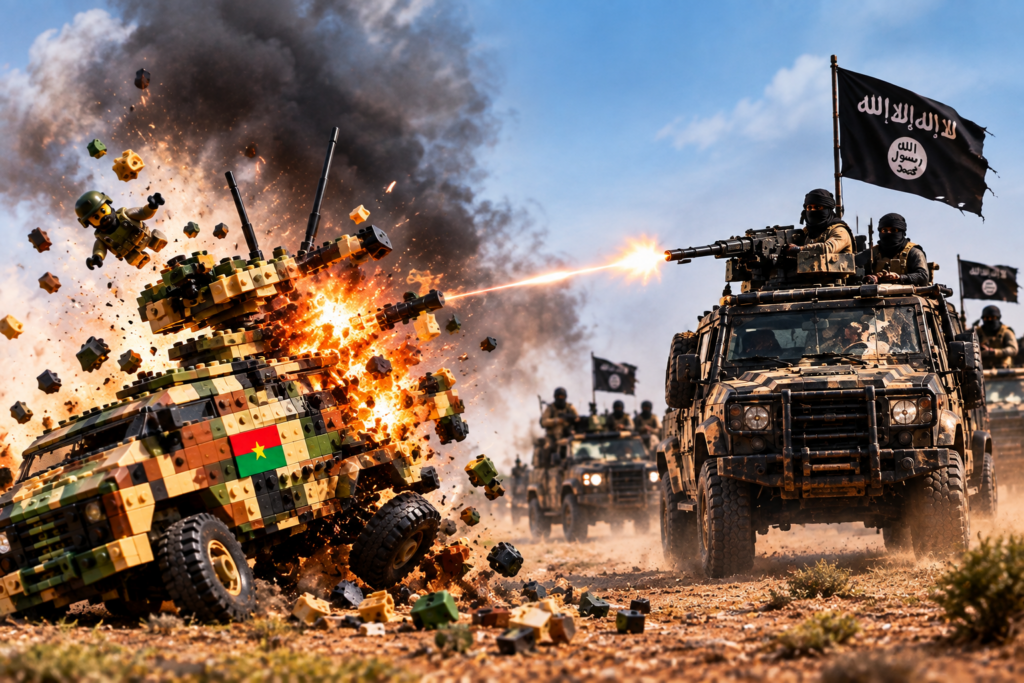
After the official unveilings and the carefully staged imagery, the moment of validation has arrived. Some observers have reached for an unkind comparison, describing certain vehicles as assembled from kits bolted together, presented, applauded, and then handed over to reality to see whether the parts truly hold.
The image is mocking. The underlying concern is not. What remains genuinely unknown is how these platforms behave under the operational conditions of northern Burkina Faso dust, heat, ambushes, and prolonged exposure to hostile fire.
A pattern that stretches back to August
The events at Mahlou and Winten did not emerge from nowhere. On 19 August, JNIM already claimed to have taken several VDP positions, including at Séguénéga and Bourzanga. Assessments of the wider conflict have repeatedly pointed to the same structural difficulty: Burkinabè forces can retake or clear territory, but sustaining control over it is a different problem altogether.
That distinction matters. Multiplying the number of sites under attack says less about any single weapon system than about the capacity to defend, resupply and reinforce them over time.
The only scoreboard that matters
If the assertion of control over Mahlou and Winten is confirmed, the message delivered by the ground will be uncomfortable. Between building an armored vehicle, displaying it, and proving it works in combat, there remains an enormous distance.
That distance is not measured in speeches, press releases or footage. It is measured in:
Kilometres of territory that are genuinely held, not merely visited;
Positions that withstand an assault rather than fall;
Soldiers who return alive to their units.
Those three indicators, and nothing else, will determine whether Burkina Faso’s armor program is remembered as a turning point or as a promise that the battlefield declined to honour.