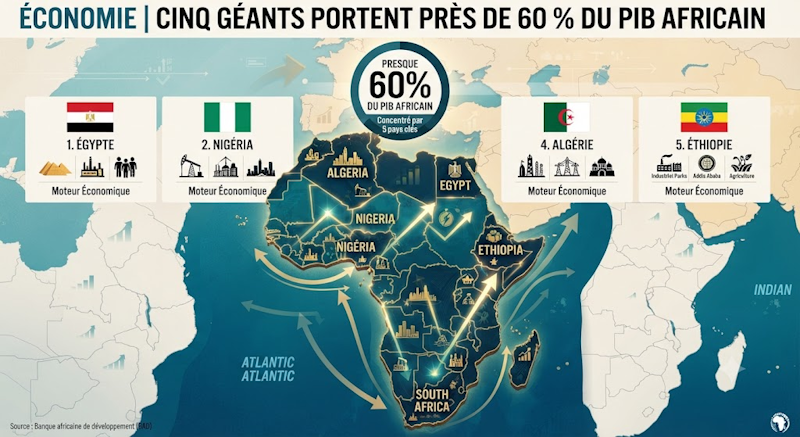
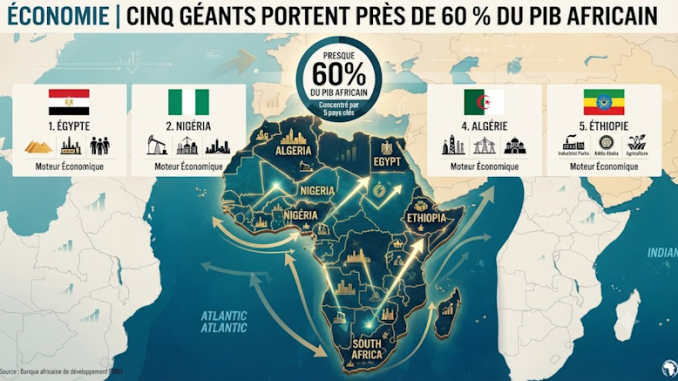
Fresh data from the African Development Bank (AfDB) reveals a striking economic reality: five nations collectively account for nearly 60% of Africa’s gross domestic product (GDP). These economic powerhouses—Egypt, Nigeria, South Africa, Algeria, and Ethiopia—serve as the continent’s primary growth engines.
This pronounced concentration underscores the outsized influence these economies wield in shaping Africa’s economic trajectory. Their dominance stems from a combination of vast natural resources, expansive domestic markets, robust industrial bases, and significant investments in critical infrastructure, positioning them as key drivers of continental prosperity.
How these five economies power Africa’s growth
Their individual strengths contribute uniquely to the continent’s economic fabric:
- Egypt and Nigeria benefit from sizable populations and increasingly diversified economic activities, with both countries expanding beyond traditional sectors.
- South Africa maintains its leadership as the continent’s industrial and financial hub, underpinned by advanced manufacturing and a sophisticated financial services sector.
- Algeria leverages its abundant energy resources and strategic public investment programs to sustain steady economic expansion.
- Ethiopia has emerged as a manufacturing hotspot, rapidly industrializing while rolling out large-scale infrastructure projects that are reshaping regional connectivity.
The widening economic divide
While these five nations propel much of Africa’s economic momentum, their outsize influence also highlights stark disparities across the continent. Many African countries continue to grapple with structural challenges, including limited industrialization, weak economic diversification, restricted access to financing, and persistent unemployment—issues that threaten to widen the gap between Africa’s leading economies and its less-developed peers.
Charting a path toward balanced growth
Economists warn that for Africa to achieve sustainable and inclusive development, fostering a more balanced distribution of economic gains will be essential. The challenge ahead lies in translating the success of these top-performing nations into shared prosperity, ensuring that growth in one region spurs opportunity across the entire continent.