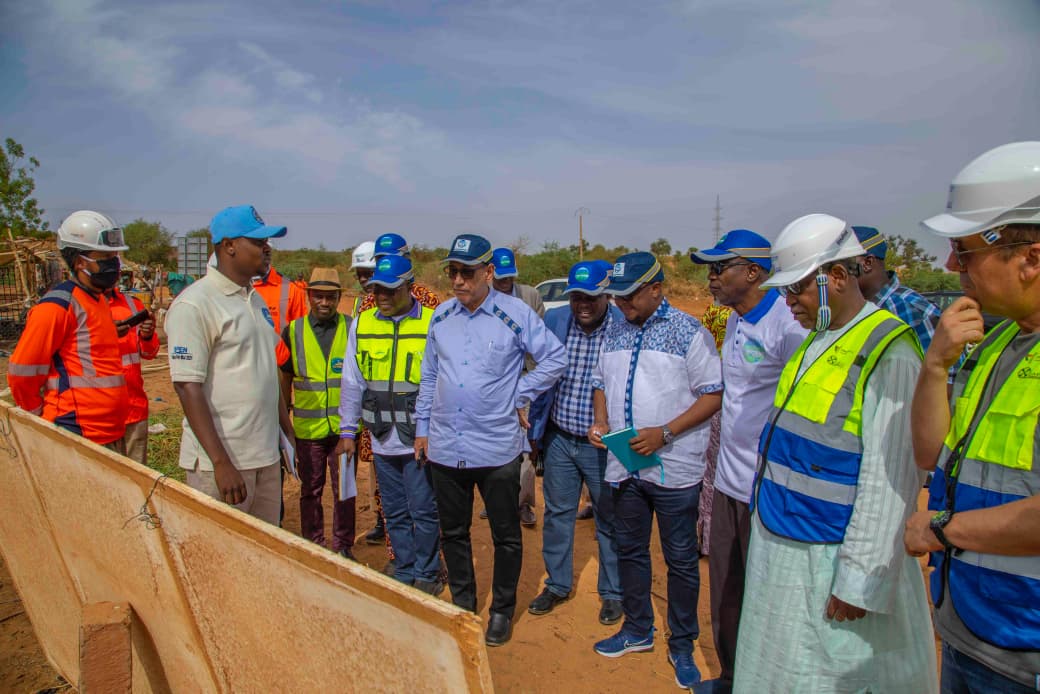
A high-level delegation from the Integrated Platform for Water Security in Niger (PISEN), the World Bank, and the Niger Water Heritage Company (SPEN) inspected key sites of Niamey’s third water treatment and production plant on June 2, 2026. The visit covered the intake structure, the treatment plant itself, and the reservoir locations on the Yawari plateau.
The third water treatment facility is a cornerstone of Niamey’s 2017 Urban and Semi-Urban Water Master Plan. Once fully operational, it will supply 250,000 cubic meters of potable water daily, delivered in three phases: 100,000 m³/day first, followed by two 75,000 m³/day increments. The goal is to meet rising demand in Niamey’s urban and peripheral districts. PISEN oversees project coordination, the World Bank provides technical and financial backing, and SPEN serves as the project owner.
Raw water will be pumped to the treatment plant under construction on the plateau. From there, two 2,500 m³ reservoirs on the Yawari plateau will store the treated water, ensuring reliable distribution to outlying neighborhoods.
securing Niamey’s water supply through 2035
Zibo Zakara, PISEN National Coordinator, confirmed that the initial 100,000 m³/day phase will guarantee Niamey’s water supply until at least 2035. The project comprises ten distinct lots, with provisions for future expansions of the river water treatment facility.
After a period of slow progress, construction has now gained strong momentum, especially at the intake site and on the Yawari plateau. Large machinery is excavating key areas, while local subcontractors employ significant manual labor, creating jobs and boosting community involvement. “Work is now advancing rapidly,” Zakara noted. “On lots six and seven, we observed excavators in full operation and local workers contributing their skills.”
world bank reaffirms commitment to Niger’s water sector
Mohamed Nanzoul, World Bank Project Manager, praised the installation’s progress and pledged continued support to the Nigerien government to improve public welfare.
a transformative project for Niamey’s residents
Haladou Laouali Amani, Construction Project Manager, reported that site mobilization, equipment installation, and preliminary studies—including topographic and geotechnical surveys—are complete. Once operational, the facility will introduce approximately 45,000 new social connections, fundamentally improving access to clean drinking water for Niamey’s growing population. “This is a landmark project,” Amani stated, “one of the largest initiatives ever undertaken to expand and strengthen potable water capacity in Niger.”