The deadliest ambush in Mali’s northern conflict in fifteen years struck near Tabrichat on July 18, leaving over 50 Malian soldiers dead and dozens missing or captured. The attack targeted a military convoy comprising Malian Armed Forces (FAMa) troops and Russian mercenaries from the Africa Corps, marking a critical juncture in the Sahel’s security crisis.
How the ambush unfolded: a coordinated strike on a vulnerable convoy
Following weeks of intense clashes to maintain control over the strategic Anéfis base, military forces initiated a repositioning operation. On July 18, a large convoy of armored vehicles and troop transports departed Anéfis, heading toward Gao, Mali’s northern metropolis. The column split into two segments: the Africa Corps mercenaries led the formation, while Malian troops followed behind.
The ambush struck near Tabrichat, a strategic crossroads linking Gao, Bourem, and Kidal. Exploiting the convoy’s stretched formation and complex terrain, fighters from the Group for the Support of Islam and Muslims (JNIM) and the Strategic Framework for the Defense of the Azawad (FLA) launched a coordinated assault, overwhelming the Malian rear section with devastating firepower.
Devastating toll and documented war crimes
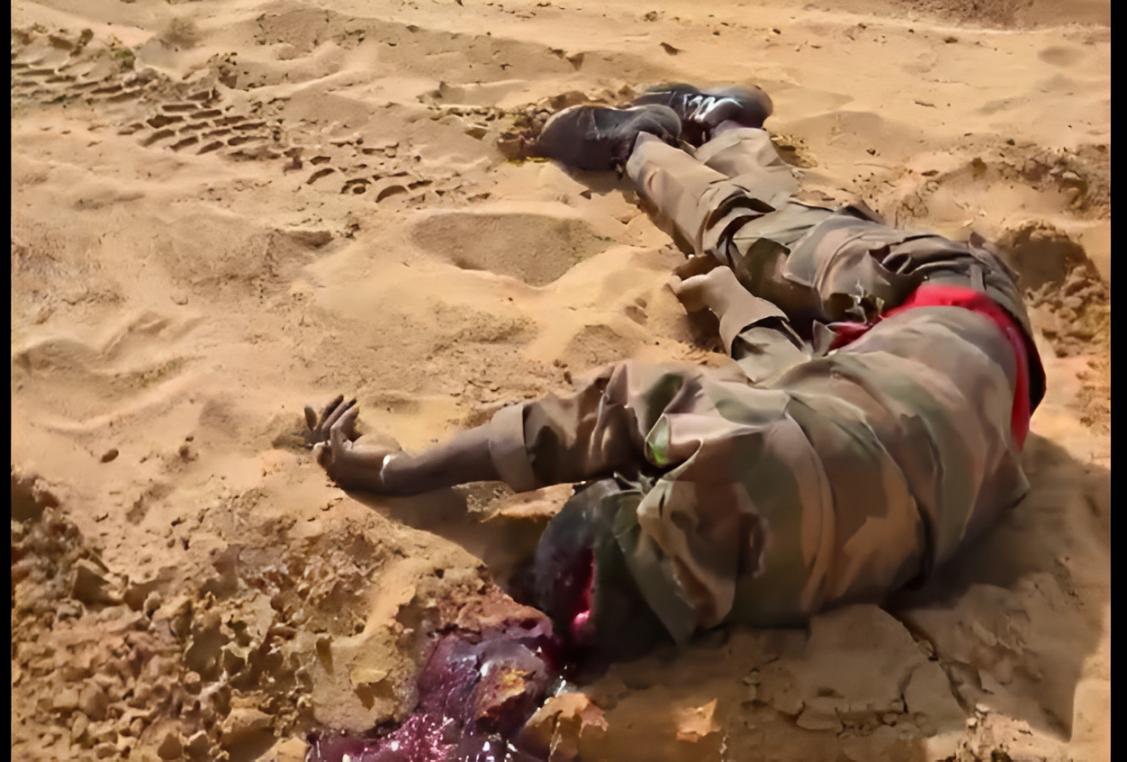
The attack left at least 50 Malian soldiers dead and 30 missing or captured—one of the heaviest losses for Mali’s armed forces in over a decade. Beyond battlefield casualties, the situation escalated when captured soldiers were executed at close range, a violation of international humanitarian law. Graphic footage, later circulated on social media, ignited national outrage, with some initial reports emerging through Africa Corps-associated channels, deepening public distrust.
Leadership in the crosshairs: Hamza Ag Gali’s role in the attack
Analysis of post-ambush imagery revealed the presence of Hamza Ag Gali, son of Iyad Ag Gali, the JNIM’s historical leader and founder of Ansar Dine. His involvement underscores the insurgent coalition’s high-level strategic planning and generational continuity within the jihadist command. The alliance between JNIM and FLA factions proved operational, demonstrating renewed tactical coordination along the Anéfis-Gao axis.
Controversial inaction: Africa Corps’ retreat raises critical questions
The Africa Corps contingent, positioned at the convoy’s front, avoided casualties during the initial assault. Yet, as Malian troops faced the brunt of the attack just kilometers behind, the Russian mercenaries proceeded to Gao without turning back to assist their allies. This decision has sparked intense debate:
- Coordination breakdown: How could two segments of the same convoy operate without mutual support protocols?
- Strategic failure: Did the Africa Corps’ refusal to intervene stem from a directive to preserve forces or an operational inability to respond?
This failure to provide critical support to a struggling ally calls into question the real effectiveness of mercenary backing in Mali’s northern theater.
Public outrage fuels demands for accountability
From Bamako’s streets to northern cities, the population’s reaction was swift and fierce. While national mourning dominates the immediate response, anger is growing toward Mali’s foreign partners. Calls for official explanations from military and government leaders are mounting, particularly regarding the convoy’s security management and the Africa Corps’ conduct.
This tragedy highlights the fragility of northern Mali’s supply routes and forces a reevaluation of the current security strategy. As the JNIM/FLA coalition shows renewed resilience and aggression, the Tabrichat ambush may compel authorities to fundamentally reassess coordination with battlefield allies.