Senegal’s economic rift: understanding the split between Sonko and Faye
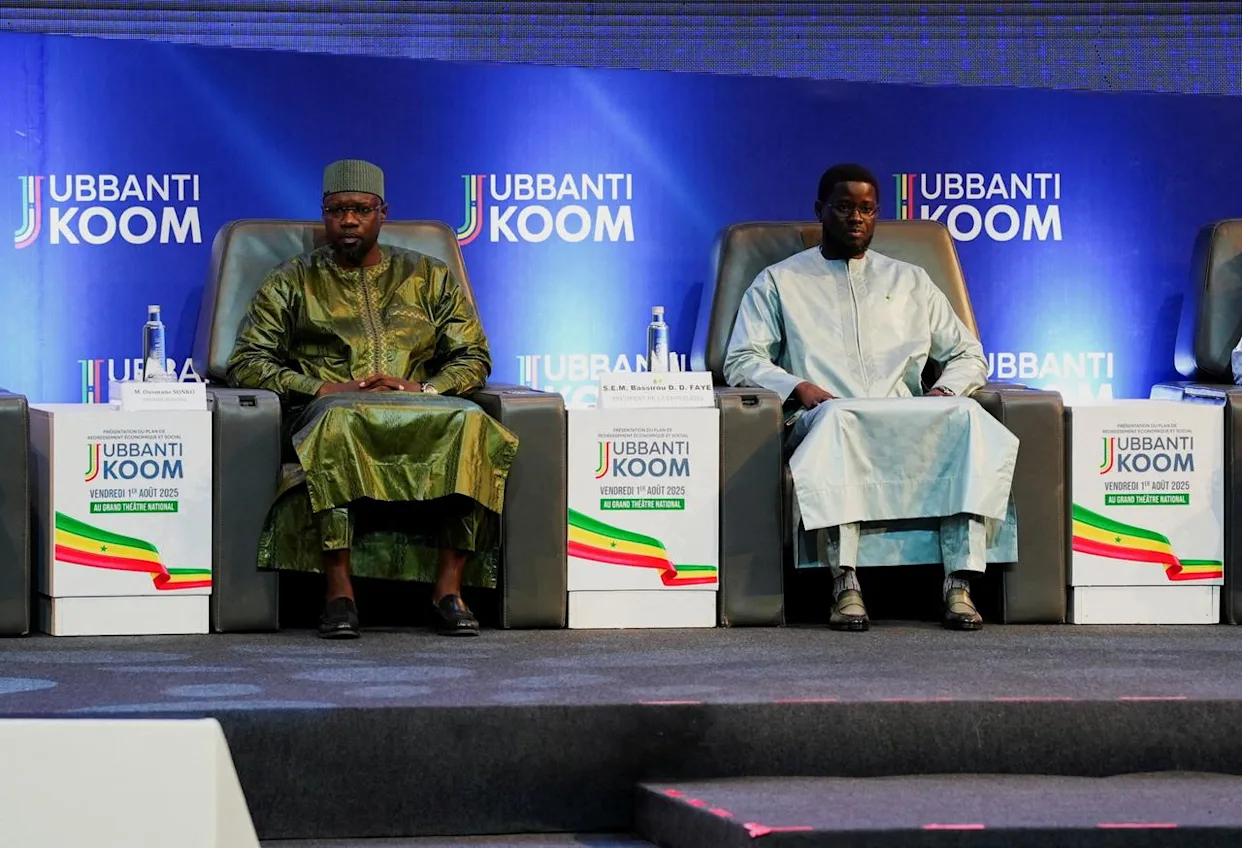
The dismissal of Ousmane Sonko by Bassirou Diomaye Faye on May 23, 2026, was not merely a clash of personalities. Instead, it underscored the irreconcilable differences between two distinct economic visions that had, for a time, coexisted under the same political banner. Two years following the pivotal change in leadership in April 2024 (when Faye was elected and subsequently appointed Sonko as Prime Minister), the leadership duo has fractured over three critical issues shaping Senegal’s economic future: national debt, hydrocarbon exploitation, and the origin of capital funding public policy.
National debt: a primary fault line
The most evident point of contention revolves around Senegal’s substantial national debt. In September 2024, Ousmane Sonko publicly exposed the extensive, undeclared indebtedness inherited from the previous Macky Sall administration. A subsequent mission by the International Monetary Fund (IMF) in March 2025 confirmed these concerns, estimating approximately 7 billion euros in unrecorded financial commitments. This revelation pushed the nation’s true debt obligations beyond 100% of its Gross Domestic Product (GDP). Servicing this debt now requires an annual allocation of 5,500 billion CFA francs, equivalent to roughly 8.4 billion euros. Furthermore, the yearly refinancing demand stands at nearly 6,000 billion CFA francs, or about 9.1 billion euros. As a consequence of this dire fiscal situation, Senegal’s sovereign credit rating suffered three downgrades within a mere twelve-month period.
Amidst this challenging backdrop, two divergent strategies emerged. Sonko firmly rejected any debt restructuring, choosing instead to make public condemnation of the prior regime a central pillar of his communications. His rhetoric resonated with the public, the diaspora, and his militant base, as he sought to avoid any perception of compromising his political legitimacy through a negotiated agreement with international institutions in Washington. Faye, however, pursued a different path. He actively engaged with the IMF through multiple channels, hosting their delegation in November 2025 and initiating a national dialogue in May 2026 to address the crisis.
With a 1.55 billion euro program suspended, international financial markets effectively closed, and the looming threat of a sovereign default by 2028, Sonko’s hardline stance, while economically unsustainable, proved politically potent for mobilizing the Pastef party (African Patriots of Senegal for Work, Ethics, and Fraternity), which he founded in 2014 and remains a dominant political force.