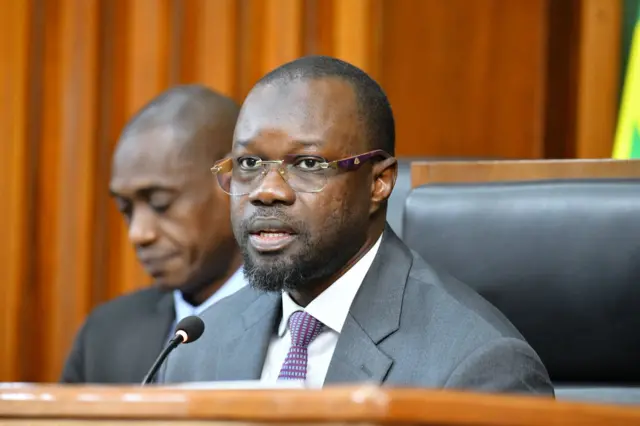
Crédit photo, ASSEMBLEE NATIONALE SENEGAL
A pivotal constitutional revision, recently endorsed by Sénégal’s National Assembly, is now set to be put before the nation in a referendum.
Justice Minister Moussa Sarr conveyed this decision to lawmakers, explaining that President Bassirou Diomaye Faye has opted for this procedure, exercising his authority under Article 103 of the Constitution.
“The President made it clear to the National Assembly Speaker that he has chosen to submit the adopted text to a referendum,” the Justice Minister stated.
This proposed reform, championed by the ruling PASTEF party, envisions a profound overhaul of the country’s institutional framework. Its objectives include bolstering the Parliament’s influence, recalibrating the distribution of powers between the President and the Prime Minister, and establishing a new Constitutional Court to supersede the existing Constitutional Council.
The decision to proceed with a referendum comes amid fervent debate within Sénégal’s political circles. While proponents hail it as a crucial stride towards modernized institutional governance, critics express apprehension, warning that the project could potentially undermine the delicate balance of powers.
This popular consultation will empower Senegalese citizens to directly weigh in on a constitutional reform that represents one of PASTEF’s central pledges for institutional transformation during the 2024 presidential election campaign.
Presented by its architects as a foundational step for institutional renewal promised by PASTEF, the reform fundamentally alters several state mechanisms: it proposes the creation of a Constitutional Court, redefines the relationship between the President and the Prime Minister, strengthens the Parliament, and enhances the separation between the presidential office and partisan activities.
Why a constitutional reform now?
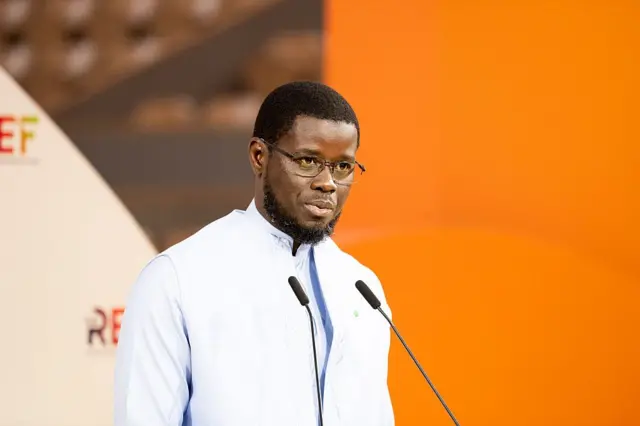
Crédit photo, AFP via Getty Images
Constitutional reform was a cornerstone of PASTEF’s platform during the 2024 presidential election. It was envisioned as a departure from the previous political system, which its proponents criticized for concentrating excessive power in the hands of the head of state.
The ascension of Bassirou Diomaye Faye to power in March 2024 ignited hopes for swift institutional change. However, the political landscape has since evolved, with the President distancing himself from the leadership of the very party that propelled him to office, despite formally remaining a PASTEF member.
This dynamic introduces a unique layer of complexity to the ongoing debate. The ruling party is now advocating for an institutional reform that directly impacts the balance among various state bodies, even as the political relationship between the President and his former party has grown more intricate.
Yet, this reform, which does not propose the establishment of a new Republic, is already generating intense discussions. Its proponents view it as an essential step to modernize Sénégal’s institutions and rectify imbalances accumulated over decades. Conversely, detractors express concern that this transformation of the political regime could disrupt the existing balance of powers.
What are the main reforms proposed in the new text?
One of the most significant transformations outlined in the text is the abolition of the current Constitutional Council and the establishment of a new Constitutional Court, endowed with considerably expanded powers.
Currently comprising seven members (a president, a vice-president, and five judges), the Constitutional Council would be replaced by a nine-member Court, including seven judges. The mandate would remain fixed at six years and be non-renewable.
However, the most substantial change lies in its redefined missions.
The newly proposed Court would ascend to become the “highest jurisdiction” across three critical domains: constitutional, electoral, and referendary matters. It would also assume a crucial role in regulating the functioning of state institutions.
Among its new competencies, the Court would oversee administrative acts related to national elections, examine exceptions of unconstitutionality raised before higher courts, and possess reinforced authority, with its decisions now binding on all natural and legal persons.
Another notable innovation is the provision allowing the Prime Minister to directly refer matters to the constitutional jurisdiction. Previously, this prerogative was limited to the President of the Republic and one-tenth of the Members of Parliament.
For those advocating for the reform, this evolution signifies a strengthening of the independence of constitutional justice. For its critics, however, the central concern revolves around the composition of the Court and the concrete guarantees of its autonomy.
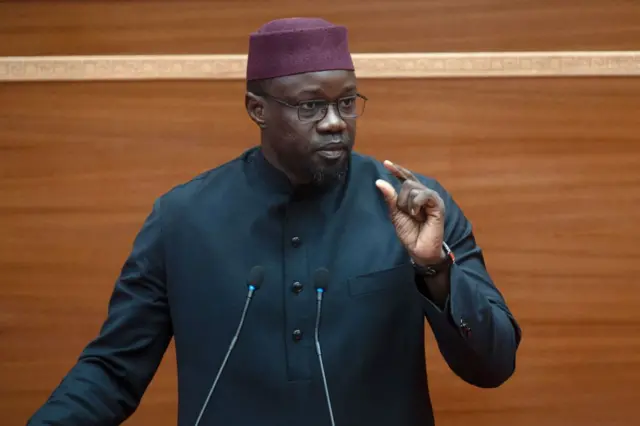
Crédit photo, Getty Images
A new balance between the President of the Republic and the Prime Minister
The reform redefines the executive power while maintaining the central role of the President of the Republic.
The current Constitution states that the President of the Republic “determines the policy of the Nation.” The updated version specifies that this determination will occur “in consultation with the Prime Minister.”
This modification introduces a principle of shared executive authority. It does not diminish the President’s sovereign role as head of state, who remains the cornerstone of institutions, but it fosters a framework of institutional cooperation.
Thus, the President retains a political orientation function, but the day-to-day conduct of governmental action could increasingly fall under the purview of the Prime Minister.
Another innovation in Article 57 would allow the Prime Minister to preside over the Council of Ministers. However, this possibility would be strictly regulated: it would only occur upon explicit delegation from the President and with an agenda set by the head of state.
The reform also formally acknowledges the existence of delegate ministers within the government’s composition.
The text, therefore, aims to mitigate the concentration of executive power around the presidency, yet it does not transform Sénégal into a parliamentary system. The President remains the central figure of the executive, but the stated objective is a more equitable distribution of responsibilities.
A reinforced separation between the presidential function and political parties
Under the current system, the President of the Republic is permitted to retain responsibilities within a political party. The proposed reform now explicitly prohibits the head of state from leading a party or a coalition of parties.
The President would only be able to hold an honorary function within a party and could participate in an electoral campaign solely when seeking re-election for their own mandate.
The text also broadens the rules of incompatibility: the President would be barred from holding any other public or private function, even if unpaid.
The stated aim is to bolster the neutrality of the presidential office and prevent any conflation between the State and party machinery.
Proponents of the text view this as a guarantee of institutional impartiality, while opponents contend that such a rule could potentially restrict the political bond between an elected President and the majority that brought them to power.
A Parliament strengthened in its oversight role
The constitutional reform envisages a significant enhancement of the National Assembly’s powers. Deputies would gain expanded means of oversight, notably through investigative commissions empowered to summon any relevant individual for hearings, as well as a right of resolution enabling Parliament to adopt guiding policy texts.
The government would also be required to demonstrate greater accountability regarding the management of natural resources, with an obligation to inform deputies about investment agreements in strategic sectors.
The reform further prohibits the simultaneous holding of a ministerial position and a local mandate, such as mayor or president of a departmental council.
Better framing the transition between two presidents

Crédit photo, Getty Images
The reform also establishes a legal framework for the transitional period between a presidential election and the new head of state’s assumption of office.
During this phase, the outgoing president would face limitations on certain decisions that could have long-term implications for the country.
Specifically, they would be barred from concluding certain strategic contracts, signing specific international conventions, or initiating new significant financial operations, unless absolutely necessary for the continuity of the State.
The objective is to prevent an administration nearing the end of its term from making weighty decisions that could unduly bind its successor just before its departure.
What remains unchanged in the reform project
Despite the proposed transformations, the constitutional reform does not challenge several fundamental tenets of Sénégal’s political system.
The President of the Republic will continue to be elected by direct universal suffrage, serving a mandate limited to two successive five-year terms.
The republican form of the State also remains unaltered, as do the fundamental principles safeguarded by Article 103 of the Constitution.
Thus, the text does not herald the advent of a new Republic; rather, it aims to reorganize the functioning of institutions and rebalance power dynamics without fundamentally altering the overall nature of the regime.