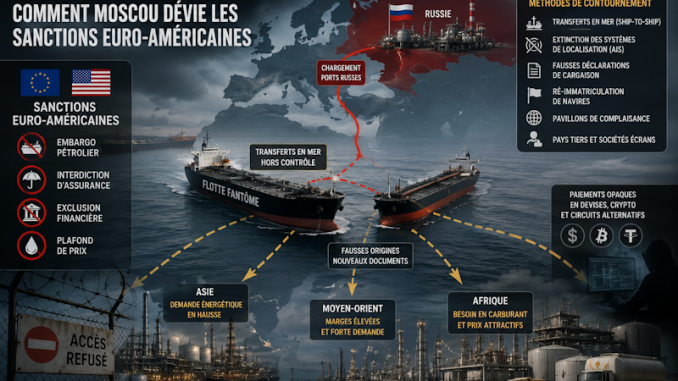
Recent investigations have uncovered a sophisticated network funneling Russian petroleum products through Morocco, enabling these sanctioned commodities to reach markets that had previously closed their doors. This elaborate system operates despite stringent Western measures imposed following Russia’s actions in Ukraine.
Geneva-based trader at the heart of the operation
Morocco emerged in 2025 as the leading importer of Russian fuel in North Africa, a position secured through the involvement of a discreet Geneva-based trader, Alvari SA. The company orchestrated multimillion-dollar shipments of Russian petroleum products, with three vessels—Tranquil Sea, Duke II, and Eldia—transporting fuel from Russian Baltic ports to Morocco’s Jorf Lasfar and Mohammedia terminals.
The case of the Tranquil Sea exemplifies the tactics used to obscure the origins of these cargoes. British sanctions lists added the vessel in October 2025 while it was en route to Morocco, shortly before the European Union and Switzerland imposed restrictions. Ukrainian defense authorities allege the ship previously served as a platform for spying on NATO military and aerial operations, while Finnish authorities detained it on suspicion of damaging an underwater cable. Alvari SA’s legal representatives denied any direct or indirect involvement in chartering or operating these vessels.
Fake certificates and shadowy transshipments
To conceal the true origin of the fuel, Cypriot chambers of commerce issued certificates falsely attributing diesel shipments to Turkmenistan. These cargoes underwent Off Port Limits (OPL) operations off the coast of Gibraltar—typically reserved for minor logistical tasks but repurposed here for high-risk fuel transfers.
Financially, transactions occurred in US dollars between Attijariwafa Bank, controlled by the royal holding Al Mada, and the offshore branch of Banque Centrale Populaire in Tangier. Moroccan distributors reportedly secured discounts of approximately seven dollars per metric ton compared to European benchmarks, while non-Russian fuels traded 15 dollars above these indices—a potential savings of 22 dollars per ton that was not passed on to consumers.
Diplomatic timing also raised eyebrows. As the Tranquil Sea approached Morocco, Foreign Minister Nasser Bourita traveled to Moscow for talks with Sergey Lavrov. Days later, Russia abstained during a critical UN Security Council vote on the Western Sahara, a decision favorable to Rabat’s interests.
Spain uncovers a potential EU rerouting
Spanish media has documented a parallel concern: a surge in diesel imports from Morocco into Spain. Industry insiders suspect a triangular trade scheme allowing Russian oil to penetrate the European Union, exploiting Morocco’s lack of refining capacity. Official data reveals Morocco imported 645,000 tons of Russian diesel in 2025, climbing to 489,000 tons in early 2026—45% of the country’s total fuel imports. Notably, Morocco did not export diesel to Spain before the Ukraine war and subsequent EU sanctions.
This resurgence coincides with regional instability. Following the US-Israel strike on Iran and the temporary closure of the Strait of Hormuz, Spain’s Strategic Petroleum Reserves Corporation reported 76,000 tons of Moroccan diesel arriving in Spanish ports like Tarragona, Barcelona, and Bilbao between April and June 2026—after nearly a year without such flows.
Spanish refiners express alarm over unfair competition. An executive from the Spanish Fuel Industry Association emphasized the need to combat potential fraud that undermines market fairness in hydrocarbon imports.
Two investigations, one unsettling conclusion
When analyzed together, these reports paint a troubling picture: Russian oil, relabeled and rerouted, transits through Morocco before potentially entering the European Union. While neither investigation claims definitive proof of every shipment following this exact route, both cite strong circumstantial evidence from maritime tracking data, customs documents, and industry testimonies. Proving the precise origin of refined products once mixed in global supply chains remains a structural challenge.