The Irony of Authoritarian Power: When Loyalty Becomes a Liability
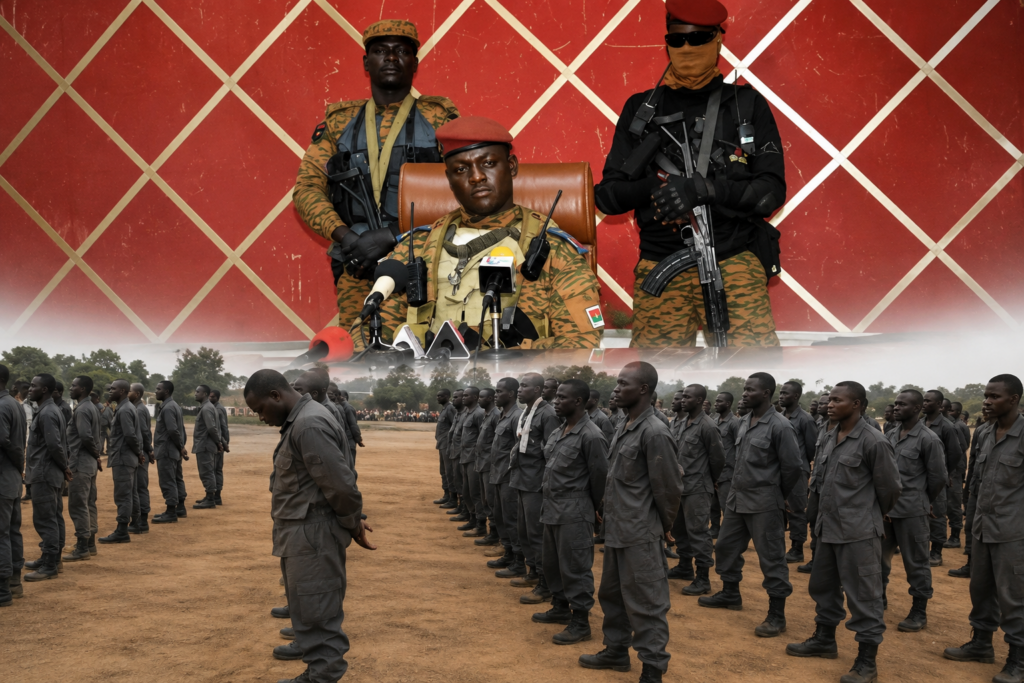
Burkina Faso’s political landscape under Captain Ibrahim Traoré is exposing a harsh truth about authoritarian rule: the very tools designed to crush dissent often end up consuming those who once wielded them. What began as a crackdown on traditional opponents—political dissidents, human rights activists, and critical media—has expanded to ensnare former regime supporters, including Muslim community leaders, civil society figures, influencers, and opinion makers who once championed the transition.
This isn’t a series of isolated incidents but a deliberate shift in the mechanics of power. As the government centralizes authority, silences dissent, and equates criticism with treason, the line between ally and adversary blurs. Loyalty, once a shield, now offers no protection—only constant recertification.
From Advocates to Targets: The Eroded Guarantee of Loyalty
Traoré’s rise was built on a narrative of sovereignty, patriotism, and security, amplified by a digital army of supporters who framed every repressive measure as a necessary defense against foreign interference or internal saboteurs. What started as strategic acquiescence—justifying arbitrary arrests as security imperatives, dismissing forced disappearances as collateral damage, applauding media closures as acts of defiance—has morphed into a system where even the slightest deviation is treated as betrayal.
The public debate has been stripped of nuance, reduced to a binary choice: unconditional support for Traoré or immediate labeling as an enemy of the state. In this climate, constructive criticism isn’t dissent—it’s heresy. The danger lies in the illusion that loyalty guarantees safety; in authoritarian systems, fidelity is a temporary contract, not a lifelong vow.
Personalized Power and the Spread of Distrust
The transition’s heavy reliance on Traoré’s persona has turned governance into a cult of personality. Policies are no longer debated; they are defended as extensions of his leadership. Criticizing a decision isn’t challenging a policy—it’s challenging the man. This personalization fuels a culture of suspicion where every setback—military failures, economic struggles, social unrest—is attributed to hidden traitors rather than policy flaws.
The circle of suspects widens relentlessly: first political opponents, then journalists, human rights defenders, judges, academics, religious leaders, and finally, former allies whose influence is deemed excessive or misaligned. No one is safe—not even those who once cheered the regime’s harshest measures.
Fear as a Governing Tool: The Cost of Compliance
The regime’s reliance on public arrests, intimidating summons, smear campaigns, and coercive requisitions isn’t just about neutralizing individuals—it’s a calculated strategy to instill fear across society. Each arrest serves as a warning. Every unexplained disappearance deepens unease. Public convocations reinforce the message that no one is beyond reach. Forced requisitions of professionals—journalists, lawyers, judges—demonstrate the regime’s reach.
This climate of fear breeds self-censorship. Intellectuals hesitate to publish. Journalists scale back investigations. Religious leaders temper their sermons. Citizens avoid public debate. A society governed by intimidation loses its capacity for innovation, self-correction, and collective problem-solving. The cost of dissent isn’t just personal—it’s societal.
The Collapse of Checks and Balances
This erosion of freedoms coincides with the weakening of institutional safeguards. An independent judiciary is increasingly questioned when rulings appear politically motivated. Independent media face suspensions or closures, narrowing the diversity of voices. Civil society organizations operate under growing restrictions. Political parties function in a climate of constraint. Without robust checks on executive power, citizens’ protections evaporate—replaced by the whims of those in control.
The lesson is stark: power untethered from accountability inevitably turns inward. Revolutionaries purge their former comrades. Military leaders suspect their own officers. Political movements sideline their founders. Ideologues face accusations of betrayal. The cycle is predictable because the logic is simple: in a system where loyalty is the currency of survival, no amount of devotion is ever enough.
Universal Truths: Rights Are Not Privileges
The current trajectory reveals a fundamental reality: human rights are not rewards for political allegiance. Fair trials, free speech, press freedom, presumption of innocence, and protection from arbitrary detention or disappearance are universal guarantees—not concessions granted to the faithful. Celebrating the repression of one’s enemies normalizes the principle of injustice, making it easier for the same logic to be applied to others. Injustice does not discriminate by target.
Many of Traoré’s early supporters made a critical error: they assumed proximity to power would shield them. But in authoritarian systems, loyalty is not a contract—it’s a provisional arrangement, constantly renegotiated based on shifting interests. Today’s ally can become tomorrow’s suspect.
Security Cannot Justify Erosion of Rights
Burkina Faso faces real terrorist threats that demand a strong state response. However, the effectiveness of counterterrorism isn’t measured solely by the volume of coercive measures. It also depends on the trust between citizens and institutions. When people fear the state more than they trust it, that trust erodes—and with it, the legitimacy needed to sustain long-term stability.
History shows that no insurgency can be defeated if institutions lose credibility with the populations they serve. Security and the rule of law are not opposing goals—they are complementary. A state that combats terrorism while upholding legal norms strengthens its moral authority. A state that normalizes exceptional measures risks transforming its fight against enemies into a justification for total control.
The System Consumes Its Own: A Political Paradox
The predicament faced by former regime supporters today reflects a broader political phenomenon. In a system where institutions are weakened and power relies on fear, no one enjoys lasting protection. Today’s staunchest defenders can be tomorrow’s accused traitors. The most vocal communicators can be sidelined. Religious leaders can be reprimanded for deviating from the official line. The system, in its hunger for absolute control, turns on those who once fed it.
But the true cost isn’t borne by individuals—it’s paid by society as a whole. When a regime extends suspicion to its own allies, it reveals a fundamental flaw: the problem isn’t the people, but the system itself. The security of a nation doesn’t depend on proximity to the leader or ideological alignment. It rests on strong institutions, an independent judiciary, a free press, and laws applied equally to all. Only within this framework can the fight against insecurity preserve both state authority and citizen freedoms.