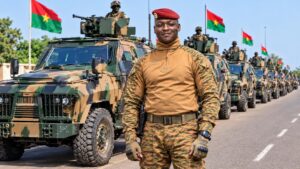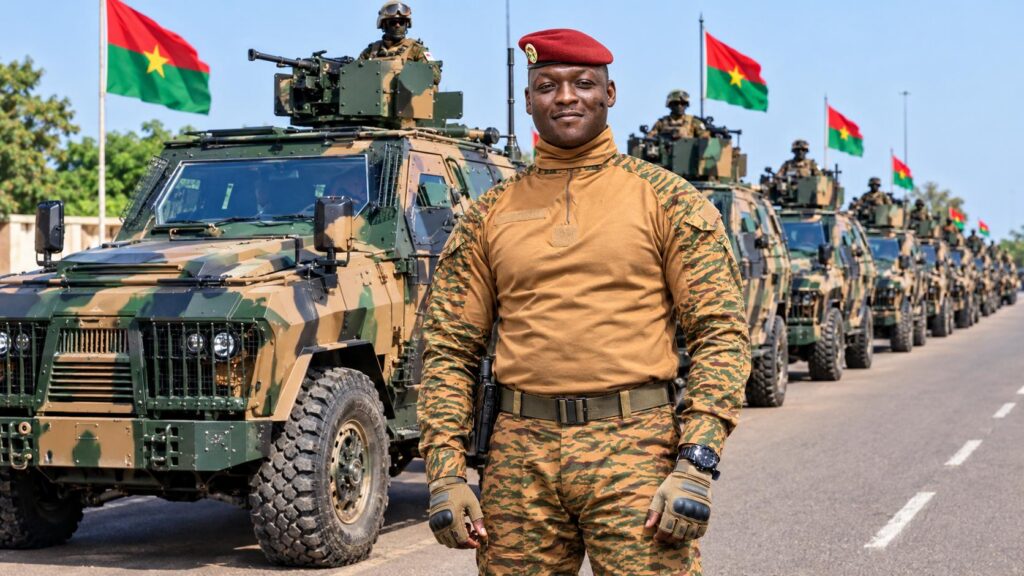
In a single dramatic announcement, Burkina Faso’s transitional president, Captain Ibrahim Traoré, declared that the nation had locally produced or adapted nearly 300 armored vehicles, dubbed “Nanga” (scorpion), since November 2025. The state-owned or mixed company “Faso Armored” was hailed as the new backbone of Burkinabè military autonomy. Yet a decisive turning point remains elusive: no one has ever seen the factory, the assembly lines are said to be strictly confidential, and the government invokes a convenient “defense secret” to block any independent verification.
Behind the self-congratulation of a “Made in Burkina” military industry, seasoned observers, military experts, and civil society actors are beginning to pull back the curtain. The question on many lips: is this formula of a “phantom factory” and “defense secret” merely a political smokescreen to hide a vast operation of overbilling and the dressing-up of civilian imports?
The “Made in Burkina” label: simple assembly or repackaging?
Building an armored vehicle is not just about welding steel plates onto a commercial chassis. It demands specialized foundries, certified ballistic steels, reinforced engines, and heavy precision engineering.
- The rebadging of commercial chassis: According to several defense industry analysts, the machines stamped “Nanga” may in reality be simple utility vehicles—mainly modified Toyota chassis—imported at low cost from third countries and then hastily reinforced in artisanal workshops.
- 300 units in 10 months: a physically impossible pace. Claiming the production of 300 armored vehicles in under a year without pre-existing industrial infrastructure is a technical chimera. For comparison, arms giants with automated factories take years to roll out such series.
“Defense secret” as a shield against budget transparency
Why keep the Faso Armored factory in total obscurity? If achieving such an industrial feat were an undeniable national pride, a supervised—even partial—media presentation would serve the regime’s propaganda.
The defense secret argument is conveniently brandished to:
- Avoid any budget oversight: Tens of billions of CFA francs are injected into military equipment orders without any public tender or audit by the Court of Accounts.
- Hide the origin and real cost of materials: Concealing intermediary suppliers and exorbitant commissions skimmed off by regime middlemen.
- Escape ballistic certification audits: No certified resistance tests (STANAG standards against mines or IEDs) have been produced, directly exposing the lives of Volunteers for the Defense of the Homeland (VDP) and soldiers sent to the front in vulnerable vehicles.
When communication replaces the reality on the front line
The Nanga armored vehicle announcement comes amid a tense political context where authorities need symbolic victories to maintain popular support. After the grand inauguration of military textile complexes like TEXFORCES-BF, the narrative of “total independence” demanded a spectacular move in heavy weaponry.
But on the ground, the tally does not add up. The persistent security deterioration in several regions shows that the escalation of announcements about “revolutionary” equipment fails to offset the deep strategic and logistical shortfalls of the armed forces.
A dangerous financial opacity for the state
By elevating financial and industrial opacity to a mode of governance under the seal of “defense secret,” the regime is sinking into a worrying drift. Between the reality of large-scale mechanical tinkering and the myth of self-proclaimed industrial sovereignty, the financial and human bill risks being particularly heavy for the Burkinabè people.