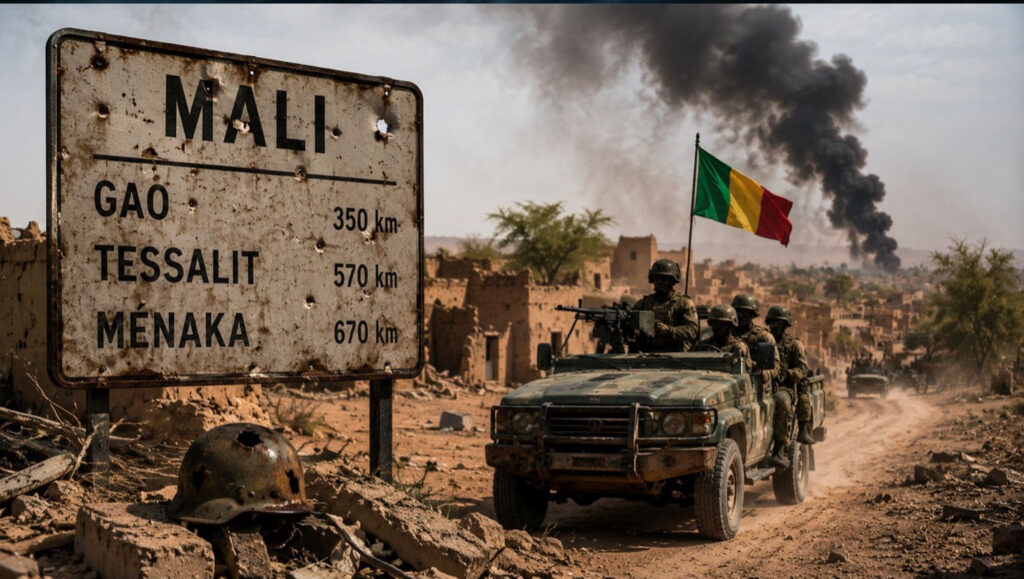
Across the vast, red dust plains of the Sahel, a region where conflict unfolds far from international scrutiny, Mali is now confronting a harsh truth: severing ties with key allies who once stood firm against escalating instability carries profound consequences. The recent surge in violent attacks plaguing the nation is not merely coincidental; it represents the foreseeable outcome of a deliberate political shift, heralded as an assertion of national sovereignty. This proclaimed independence, often amplified by strong anti-French sentiment, has served as a domestic legitimizing tool for the current Malian leadership.
Bamako sought the departure of French forces, and it was achieved.
The final French military convoys exited key locations like Gao, Tessalit, and Ménaka, met by derision from segments of the public, inflamed by years of accusatory rhetoric. At the time, operational realities seemed secondary. Little consideration was given to the pivotal moment in 2013 when French forces intervened decisively, halting the imminent collapse of the Malian state as jihadist columns threatened to advance southwards.
President Emmanuel Macron of France underscored this reality with a stark observation: « Le Mali n’a pas pris la meilleure décision en chassant l’armée française ». This simple, almost clinical statement now resonates as an undeniable strategic truth.
While acknowledging past French missteps, including at times overestimating military solutions without sufficiently pushing for vital local political reforms, the French President has remained steadfast on one crucial point: without the French intervention, Mali faced potential disintegration. He previously asserted without ambiguity: « Sans la France, le Mali ne serait plus un État uni ».
This fundamental truth appears to be re-emerging with brutal clarity.
The ground reality, unswayed by slogans or political posturing, swiftly revealed a stark security vacuum once French bases were vacated. Groups affiliated with Al-Qaida and the Islamic State wasted no time exploiting these new vulnerabilities. Where Operation Barkhane once contained, monitored, engaged, and gathered intelligence, Malian authorities now struggle to maintain lasting control over their expansive territory.
Behind these developments lies a memory that demands respect and recognition.
Fifty-eight French soldiers perished in the Sahel.
Fifty-eight individuals lost their lives in a conflict that was neither abstract nor theoretical. They fell in places like Kidal, in the Adrar des Ifoghas, at In Delimane, on roads riddled with improvised explosive devices, during nocturnal operations, under oppressive temperatures, and against a diffuse, mobile, and elusive adversary.
These soldiers were not occupiers. They were not colonial predators disguised within a militant narrative. They represented the instruments of a military commitment undertaken by the French Republic to prevent the establishment of a terrorist sanctuary at the very heart of the Sahel.
They paid the ultimate sacrifice.
Their sacrifice imposes at least one imperative: to ensure their memory is not diluted by ideological oversimplifications.
Indeed, France made errors. Yet, for years, it also bore, almost single-handedly, a colossal military burden to preserve an already fragile regional balance.
Mali chose to dismantle this security architecture in the name of a declared independence. It now faces the full implications of that decision.
President Macron’s declaration that Bamako did not make “the best decision” was not an expression of post-colonial resentment or sentimental regret. It was a simple observation of what reality is now cruelly confirming: in certain parts of the world, declared sovereignty alone is insufficient to contain advancing jihadist forces.
For France, the Sahel became a theater of diplomatic attrition.
But for French soldiers, it remains something more profound: a field of honor.
And that honor is not subject to the shifting winds of public opinion.