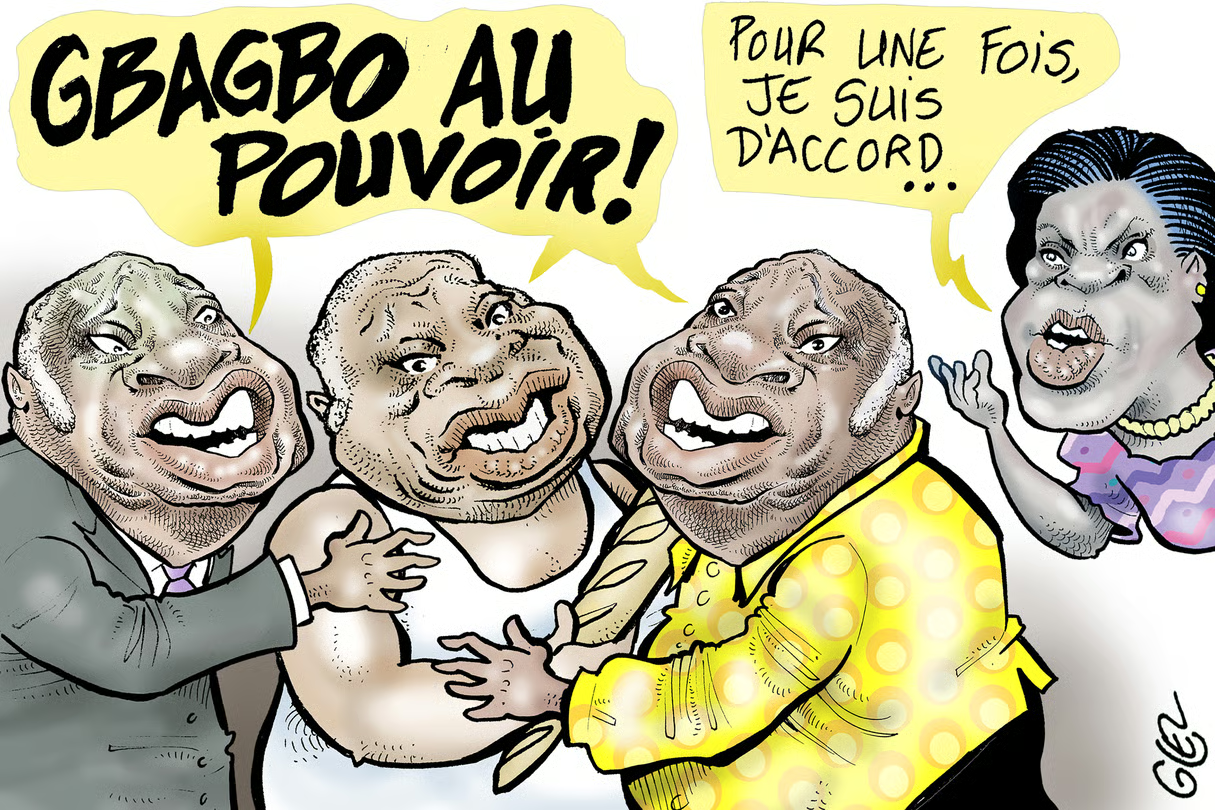
After years of political exile and legal battles, Côte d’Ivoire’s former President Laurent Gbagbo has once again taken center stage in his party’s leadership. The octogenarian leader, whose presidential ambitions were thwarted by a technicality, has defied expectations by reclaiming the presidency of the Parti des Peuples Africains-Côte d’Ivoire (PPA-CI) during its first ordinary congress, held over the weekend in Abidjan.
Political comeback or strategic maneuver?
The decision came as a surprise to many, especially given Gbagbo‘s earlier hints at stepping back from active politics. His mentor, Alassane Ouattara, had just secured another term, extending his grip on power. Analysts suggest Gbagbo‘s return may stem from a mix of internal party pressures and public demands for his continued involvement in guiding a nation he believes faces profound challenges.
The PPA-CI, which has abstained from both the last presidential and recent legislative elections in 2025, now faces a critical juncture. Gbagbo was reappointed by acclamation—a move that, while projecting an image of unity, masks deeper divisions within the party.
Internal strife and disciplinary measures
The congress in Abidjan’s Palais de la Culture was not just a celebration but a necessary realignment. The party’s central committee expelled three prominent dissenters and suspended 62 others, including former parliamentary candidates and local officials. Among those penalized were Prince Arthur Dalli, mayor of Lakota, independent deputy Stéphane Kipré, and professor Georges Armand Ouégnin.
These figures had openly challenged the party’s boycott strategy and advocated for sweeping reforms, including leadership renewal and a more equitable distribution of roles. Their exclusion from the congress underscores the ongoing power struggle within the PPA-CI.
The party’s decision to reappoint Gbagbo—a move framed as both continuity and renewal—highlights the delicate balance between tradition and transformation. While the former leader may no longer manage the party’s daily affairs, his symbolic presence remains undeniable. As one observer noted, old habits die hard, especially for a figure as entrenched in Ivorian politics as Gbagbo.
The 14–15 May congress marked more than just a leadership transition; it was a statement of resilience. Whether this marks the beginning of a new chapter or the final act in Gbagbo‘s political saga remains to be seen.