Reporting from Boston, a familiar, unsettling echo of 1998 hung heavy in the air. The same bright sun, the same defiant names (Enciso, Paredes, Arce, Sanabria), the iconic red and white striped jerseys of Paraguay, and an impenetrable defensive wall that Germany’s Mannschaft battered against without success. Unlike France in that historic year, Germany found no last-minute hero to break the deadlock. In a shocking turn of events on Monday in Boston, the German squad was eliminated from the World Cup in the Round of 16, falling to Paraguay in a dramatic penalty shootout (1-1, 4-3 t.a.b.). This marks a significant upset, especially for a team widely considered a strong contender.
For the third consecutive tournament, after similar early exits in 2018 and 2022 (when the format included only 32 teams), Germany has failed to advance beyond the initial knockout stages. More remarkably, this defeat shatters their long-standing invincibility in World Cup penalty shootouts – a domain where they had previously never faltered. The palpable dismay among German journalists in the press box underscored the sheer magnitude of this footballing disaster.
“we didn’t succeed,” laments kimmich
“This is one of the worst days for German football,” one journalist somberly shared in English in the mixed zone, quickly retreating as jubilant Paraguayan counterparts, draped in their national colors, celebrated their unexpected triumph. Meanwhile, Joshua Kimmich, the German captain, faced the media with a strained expression, attempting to articulate the inexplicable.
« “It’s terrible,” Kimmich confessed. “As a child, I watched the national team reach World Cup semi-finals and finals. There were always great successes that influenced me. And that’s a joy we want to give to the children and the people back home. We didn’t succeed.” »
Kimmich’s own performance mirrored the team’s struggles. Typically a central midfielder for Bayern Munich, he was deployed in an ambiguous hybrid role – neither a true central defender, nor a right-back, nor a holding midfielder. This tactical uncertainty severely destabilized the team, particularly the right flank, where Leroy Sané, appearing alarmingly out of form, received no support when cornered by opponents.
unfathomable tactical choices under scrutiny
Against Paraguay’s tightly organized defense, the German offense was toothless. They created virtually no chances in the first half. A header from Havertz after the break, followed by a few long balls and crosses into the box, was the extent of their attacking threat. Orlando Gill, the South American goalkeeper, was rarely tested. The substitutions made by Julian Nagelsmann did little to alter the course of the match.
The German coach, once hailed as a prodigy in the Bundesliga with Hoffenheim in 2016, now faces intense criticism across Germany. Beyond the improbable outcome of the evening, his incomprehensible tactical decisions, such as introducing Goretzka at halftime or Woltemade at the very end of the match, are under fire. His selection of certain players for the trip to the United States, including Jonathan Tah, Leroy Sané, and even Manuel Neuer, has also drawn significant scrutiny.
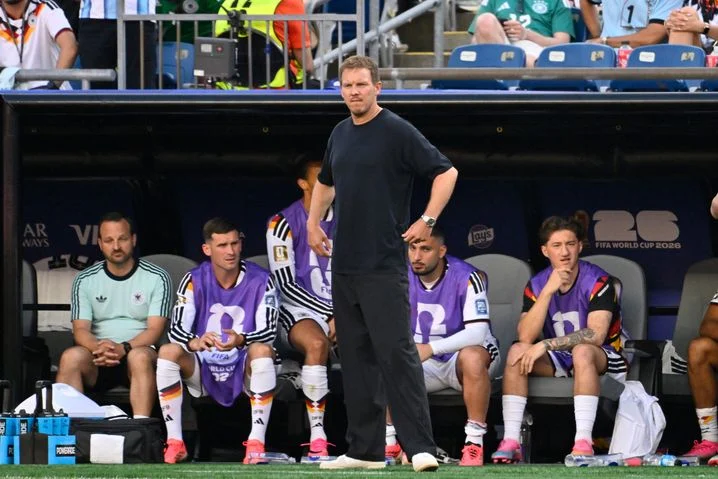
Manuel Neuer, who had previously retired from international duty, made a comeback in recent weeks, and Nagelsmann opted to include him in the squad despite his 40 years of age, a challenging season with Bayern, and the convincing performances of Oliver Baumann in goal for Germany until then. As one journalist noted before the match, “Neuer was also part of the failures in 2018 and 2022, having been selected at the last moment. It’s a big mistake to have brought him.”
« “And that’s something that unsettled the group,” the journalist asserted. “While the Bayern players supported his return, others were far less enthusiastic. Manuel Neuer wasn’t even among the top six goalkeepers in the Bundesliga this season. We won’t go far in the World Cup with him.” »
nagelsmann’s future in doubt?
The journalist’s foresight proved accurate, even though Manuel Neuer delivered a respectable performance, making two crucial saves and, notably, stopping Paraguay’s fifth penalty, which briefly reignited hope. But it was in vain. Beyond Neuer, Sané, or Tah, it is Nagelsmann himself who is increasingly drawing ire. Following the humiliation in Boston, the coach was inevitably questioned about his future. His response was resolute:
Despite a heated exchange with a German journalist post-match, Nagelsmann found support from his captain, Joshua Kimmich, who he also coached at Bayern Munich: “I think Germans need something to be proud of right now. Unfortunately, it’s not the national team. We, the players on the field, made mistakes, and we take responsibility for them. It wasn’t the coach, it wasn’t the media, it wasn’t the referee, it wasn’t the opponent. It was us.” Meanwhile, France (or perhaps Sweden, let’s not get ahead of ourselves) must be quietly celebrating Germany’s unexpected early departure.