Gabon’s president outlines vision for economic sovereignty and reform
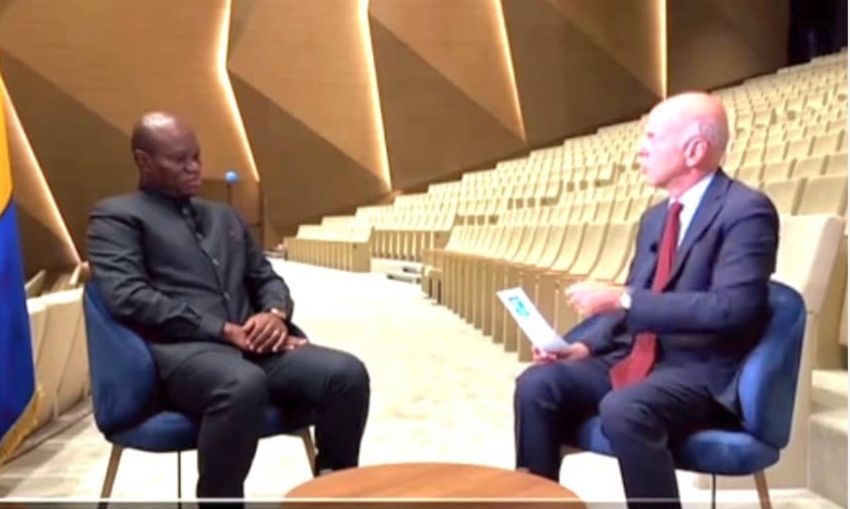
Libreville, June 3, 2026 – In a carefully staged media appearance, Gabonese President Brice Clotaire Oligui Nguema used his first major international interview to defend his government’s reform agenda, assert economic sovereignty, and dismiss concerns about dynastic succession.
Three years after assuming leadership and one year into his seven-year mandate following an election that secured over 94% of the vote, the president granted an exclusive interview from the Congress Hall of the Cité de la Démocratie in Libreville. The conversation, aired on an international news channel, served as both a progress report and a platform to address pressing national and global issues.
The president’s remarks revealed a deliberate political strategy: one that prioritizes long-term structural reforms, economic independence from foreign corporations, and a recalibration of Gabon’s international partnerships without severing ties. This approach reflects a government committed to gradual transformation rather than rapid, superficial change.
Progressive reforms take center stage
Criticisms regarding the pace of infrastructure development—particularly in access to clean water and reliable electricity—were met with a measured response. The president acknowledged public frustrations but emphasized that his administration’s seven-year mandate was designed to deliver lasting improvements, not quick fixes.
With over 800 billion CFA francs invested in energy infrastructure, Oligui Nguema argued that meaningful change requires patience. His message underscored a governance philosophy centered on sustainable planning and measurable milestones, rather than short-term political gains.
Economic sovereignty as a guiding principle
The most consequential declarations came on the economic front. The president confirmed Gabon’s intention to engage with the International Monetary Fund—but only after a comprehensive audit of the country’s financial health. This cautious stance signals a desire to regain control over public debt management before entering new international agreements.
In a bold move aimed at reshaping Gabon’s mineral economy, Oligui Nguema announced a ban on the export of raw manganese starting in 2029. As one of the world’s top producers, Gabon currently ships unprocessed ore abroad. The new policy mandates local processing, with a clear ultimatum: foreign mining groups like Eramet must establish refining facilities before the deadline or face export restrictions. This decision marks a decisive shift away from the export of raw materials toward value-added industrialization at home.
Balanced diplomacy in a shifting global landscape
On the international stage, the president reaffirmed Gabon’s commitment to balanced partnerships. Despite global pressures for self-reliance, he stressed that sovereignty does not equate to isolation. A state visit to France scheduled for July 20 was highlighted as a testament to strong bilateral relations built on mutual respect, not dependency.
The return of the Camp de Gaulle military base to Gabonese authorities was framed as part of a collaborative process, contrasting sharply with the confrontational approaches seen elsewhere in the region. Similarly, when addressing a U.S. proposal to host deported migrants, the president firmly stated that such an arrangement did not serve Gabon’s interests, despite maintaining cordial relations with Washington.
Rejecting dynastic rule and embracing democratic transition
In a region where political power often lingers or passes between family members, the president took a firm stand against any form of hereditary leadership. He categorically denied any plan to establish a political dynasty under his name, affirming that the seven-year, one-term limit is a permanent fixture of Gabon’s democratic framework. This declaration reinforces his pledge to build a political system anchored in transparency and regular alternation in power.
A vision under scrutiny
The interview laid bare the pillars of Gabon’s evolving governance model: economic sovereignty, local resource transformation, balanced international relations, and incremental infrastructure reform. While the president’s political capital remains strong, the true test lies ahead—can this vision translate into tangible improvements for the Gabonese people?
One year into his term, Brice Clotaire Oligui Nguema has staked his presidency on a simple yet ambitious promise: to reclaim Gabon’s economic and political destiny. Whether this promise endures will be decided not by words, but by the daily lives of its citizens.