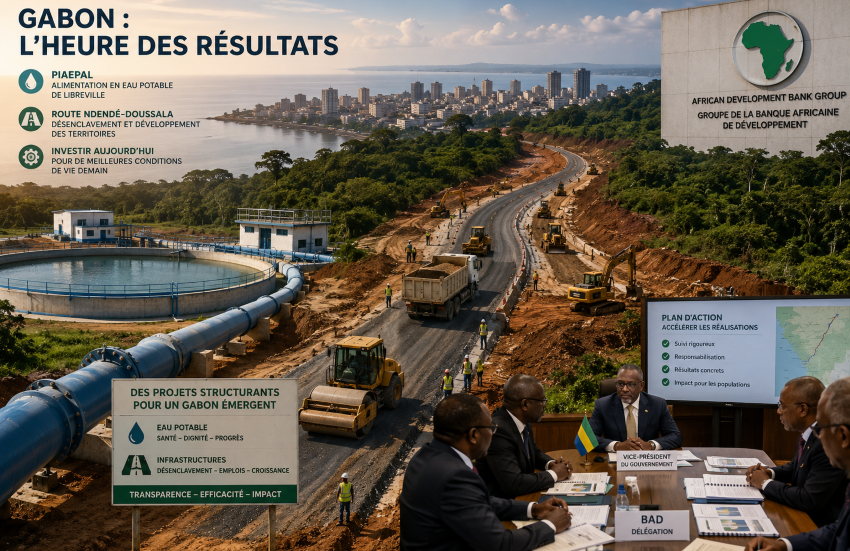
Libreville has decided to adopt a firmer stance regarding its development agenda. Faced with persistent delays affecting several initiatives supported by the African Development Bank (AfDB), the government is now insisting on concrete outcomes.
During a high-level meeting held in Libreville between the Vice President of the government, Hermann Immongault, and an AfDB delegation led by Country Manager Mamour Ousmane Ba, a central priority was established: transforming mobilized loans into visible improvements for the population.
Two major projects are currently under the spotlight. First is the Integrated Program for Drinking Water Supply and Sanitation in Libreville (PIAEPAL), which aims to provide a sustainable solution to water access issues in the capital. Second is the Ndendé-Doussala road, a vital infrastructure project designed to boost regional integration and economic trade with neighboring countries. Both sites are considered top priorities, yet their slow progress continues to spark public frustration.
Putting an end to project delays
For several years, Gabon has secured significant funding from international institutions to modernize its national infrastructure. However, many of these projects have struggled to stay on schedule, leading to growing impatience among the public. This recent dialogue with the AfDB signals a major shift in the official approach, moving toward a culture of performance and accountability.
The executive branch is now demanding that every cent of funding results in a measurable impact on the daily lives of Gabon citizens. This requirement is particularly critical as budget constraints tighten. For the authorities, the focus is no longer just on securing resources, but on ensuring their total efficiency. The public is judging the government not by the amounts invested, but by the physical structures completed.
The PIAEPAL initiative is a prime example of these high stakes. With water shortages remaining a frequent issue in many Libreville neighborhoods, expectations are immense. Every delay erodes the credibility of public programs. Similarly, the Ndendé-Doussala road, long promised as a catalyst for economic development, continues to face hurdles that postpone the benefits intended for local businesses and residents.
A shift toward shared responsibility
A significant takeaway from the discussions is the acknowledgement that delays are often caused by a variety of factors across different sectors. Hermann Immongault highlighted the need to clarify the roles of all stakeholders and pinpoint the exact bottlenecks stalling execution. This transparent approach moves away from the habit of blaming external contractors or lenders exclusively.
By recognizing internal administrative shortcomings, the government admits that heavy bureaucratic procedures, poor coordination between agencies, and slow decision-making processes often hinder progress. This level of self-awareness is a vital step toward reform, as chronic delays in large-scale projects often stem from systemic governance issues rather than a single failing party.
Testing the credibility of national reforms
The AfDB remains supportive but cautious. Mamour Ousmane Ba reiterated the institution’s commitment to Gabon‘s priorities while noting that he would convey the government’s new directives to the bank’s leadership. This highlights a fundamental truth in international partnerships: while funding can be provided, success depends entirely on the host nation’s ability to execute.
The ultimate test for this new governmental strategy will be its ability to deliver rapid, measurable results. The completion of the Ndendé-Doussala road and improved water access in the capital are now the primary benchmarks for this political shift. They will serve as proof of whether the change in tone in Libreville will lead to a genuine change in methodology.
In a global environment where competition for international financing is fierce, the most attractive nations are those that can effectively turn debt into operational infrastructure. The message sent to the AfDB is unmistakable: Gabon wants every funded project to become a reality. The question remains whether this new demand will finally end the cycle of delays that has long plagued the nation’s major construction efforts.