Turning the tide: how Côte d’Ivoire links debt to human capital
In a bold strategic shift, Côte d’Ivoire took center stage at the UNICEF high-level forums in New York on September 21–22, 2026, presenting its pioneering approach to turning sovereign debt into an engine for education and learning outcomes. Dr. Souleymane DiarraSSOUBA, Minister of Planning and Development, outlined how the country is reimagining public finance to place children’s futures at the core of debt sustainability discussions. The move marks a decisive pivot from traditional debt-management toward outcome-linked financing that rewards measurable educational progress.
AI and education finance: Côte d’Ivoire unveils sustainability-linked lending
The Minister kicked off the first session of the Learn AI Global Compact under the banner “Responsible AI for Every Learner,” where Côte d’Ivoire shared its experience with sustainability-linked sovereign debt. In 2025, the country issued a landmark €433.3 million loan whose financing costs adjust in line with verified results in renewable energy expansion and forest restoration. Backed by the World Bank’s IBRD and MIGA guarantees, this transaction became Africa’s first sovereign sustainability-linked loan in West Africa.
Building on that momentum, discussions in New York turned to extending the same mechanism to human capital. A proposed education performance-linked bond would tie interest payments directly to national learning outcome indicators—transforming debt into a performance-based investment in children. The model calls for rigorous, independently auditable metrics, prudent risk management, and alignment between loan tenors and the lifecycle of education investments. It also underscores data privacy for learners and the shared responsibility of governments and educators in shaping curricula and pedagogy.
From pledge to practice: embedding AI and digital learning in the 2026–2030 plan
The PND 2026–2030 lays out Côte d’Ivoire’s roadmap for scaling AI-driven education systems and digital training platforms. The government has committed to deepen collaboration with UNICEF and the Learn AI Global Compact to define verifiable learning indicators and design robust guarantee structures that ensure value-for-money while protecting public budgets. This institutional alignment signals a decisive shift from rhetoric to implementation, positioning education technology as a lever for equitable, future-ready skills development across the country.
Debt strategy reimagined: turning obligations into opportunities for children
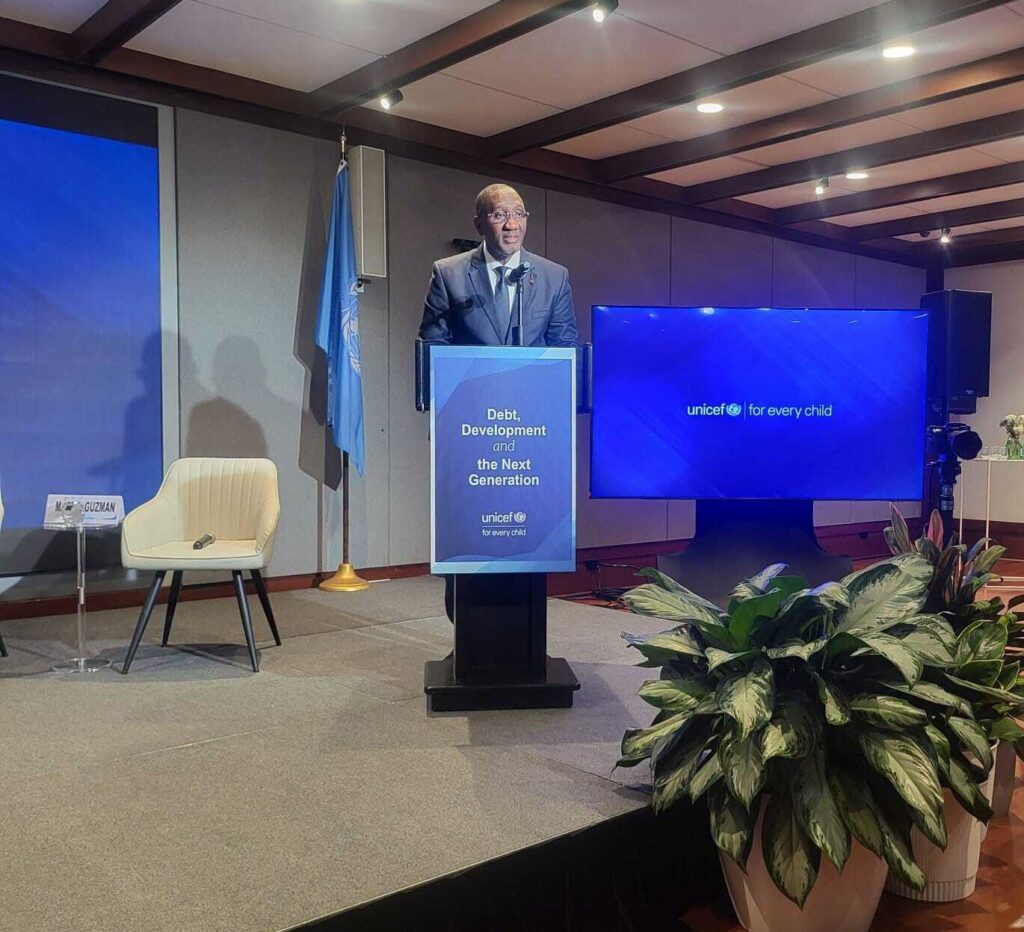
On the second day, the Minister addressed UNICEF’s forum on debt, development, and future generations, where he emphasized that the burden of debt is not inherent—it is shaped by how funds are used, structured, and priced. With nearly 400 million children living in nations where debt burdens now outpace investments in health, schooling, and nutrition, Côte d’Ivoire’s stance offers a counter-narrative: debt can be humanized when aligned with national priorities that safeguard childhood.
The PND 2026–2030 enshrines human capital development at the heart of policy, targeting milestones in maternal and child health, universal health coverage, social protection, and the World Bank’s Human Capital Index. Parallel to this, the country has adopted a risk-conscious debt management framework—safeguarding fiscal sustainability while seeking optimal financing terms. In 2024, with support from the World Bank Group, Côte d’Ivoire executed a debt-for-development swap, converting nearly €400 million of commercial debt into development commitments. Over five years, this move is expected to unlock approximately €330 million in budget space, with a significant share earmarked for education through domestic financing mechanisms.
A ‘human-faced debt’ isn’t one that’s erased. It’s one whose allocation, structure, and cost are deliberately aligned with the health, education, and protection of every child.
Charting the path forward: three pillars of Côte d’Ivoire’s finance revolution
- Debt for impact: Swapping debt for verifiable social outcomes—starting with education—while maintaining fiscal prudence.
- Risk-first financing: Embedding sustainability and guardrails to prevent future debt crises from undermining children’s development.
- Technology as enabler: Harnessing AI and digital tools to measure, manage, and improve learning while respecting data sovereignty.
By positioning education at the nexus of debt strategy, Côte d’Ivoire is not merely refinancing loans—it is redefining the social contract between the state and its youngest citizens. The breakthrough unveiled in New York signals a global shift: when finance is governed by impact, every euro borrowed can become an investment in a child’s tomorrow.