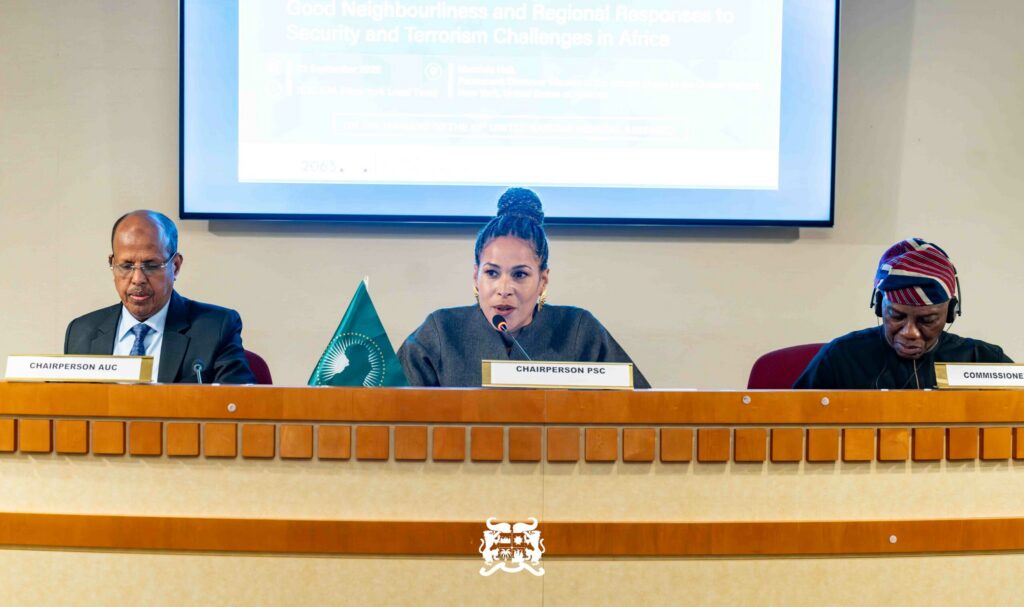
During a pivotal moment at the 81st United Nations General Assembly in New York, Benin orchestrated a decisive shift in continental security policy. On September 23, 2026, Foreign Minister Corinne Amori Brunet led the 1369th session of the African Union Peace and Security Council (AUPSC)—held at ministerial level—where good neighborliness emerged as the cornerstone of Africa’s response to terrorism and cross-border threats.
The high-level meeting convened key stakeholders including African Union Commission Chairperson Mahmoud Ali Youssouf, Commissioner for Political Affairs, Peace, and Security Bankole Adeoye, and representatives from AU member states, regional bodies, and international partners. Against the backdrop of rising insurgency and destabilization across the Sahel, Benin positioned itself at the vanguard of a regional diplomacy makeover.
From borders to bridges: redefining security through regional cooperation
Minister Brunet opened the session by framing national borders not as divisive lines, but as interconnected lifelines for over 25 million people whose daily lives—livelihoods, trade, and cultural ties—span multiple countries. “When insecurity takes root across these zones, its impact transcends single territories,” she emphasized. “The answer lies in turning neighbors into partners.”
Benin’s strategy hinges on four pillars:
- Visible state presence in border areas to deter extremist infiltration
- Real-time information sharing among security agencies across nations
- Judicial and security cooperation to dismantle trafficking and militant networks
- Preservation of legitimate cross-border exchanges that sustain communities
Neighborly diplomacy under fire: maintaining cooperation amid political tensions
The session revealed a paradox: while geopolitical disputes often escalate, Benin advocates for continuity in crisis prevention. “We don’t need new frameworks—we need to strengthen existing ones and adapt them to local realities,” said Brunet. This pragmatic approach aligns with President Romuald Wadagni’s broader foreign policy vision, which elevates dialogue, regional security, and cooperative governance as pillars of Benin’s external action.
The role women play in turning crisis zones into stable frontiers
Amid discussions on surveillance and counterterrorism, delegates spotlighted a previously overlooked asset: the women living along these borders. Their intimate knowledge of terrain, social networks, and early warning signs positions them as critical actors in conflict prevention and peacebuilding.
This focus reflects the outcomes of the Second High-Level Ministerial Seminar on Women, Peace, and Security—held in Cotonou earlier this month—where gender-inclusive security solutions were prioritized. The New York session extended this momentum, linking grassroots insights to high-level security architecture.
As the AU’s two-year presidency cycle under Benin’s leadership nears its final stretch, this week’s breakthrough signals a turning point: a shift from reactive border patrols to proactive regional resilience. The momentum continues on September 28, when Minister Brunet takes the UN podium to outline Benin’s vision for a unified African security front.