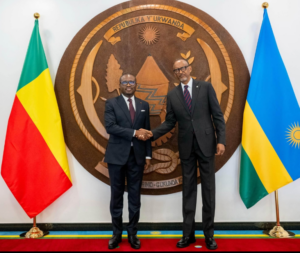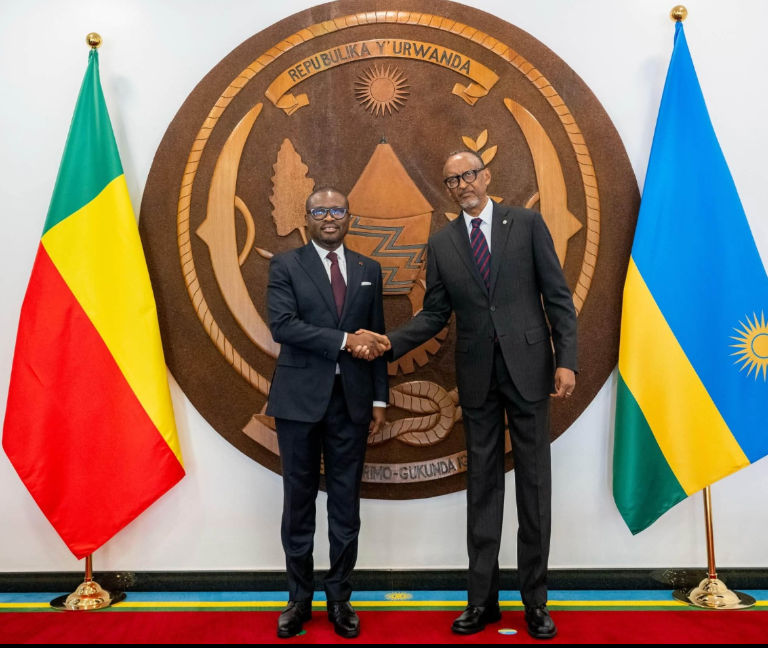
KIGALI — When Romuald Wadagni touched down in Kigali on Wednesday, September 16, 2026, the choreography of the two-day state visit told its own story. For Benin’s president, sworn in only last May, this was his first official diplomatic mission of its kind, and the itinerary had been drawn with unusual care: a welcome by crowds along the route, a reception at Urugwiro Village by Paul Kagame, and — set squarely within the programme — a solemn stop at the Kigali Genocide Memorial in Gisozi.
The inclusion of that memorial visit is anything but incidental. It reveals how Cotonou is reading its own opening to Kigali: not simply as a round of institutional handshakes, but as an exercise in shared memory, calibrated to build trust with a partner whose national identity has been shaped, in part, by the aftermath of 1994.
What the Urugwiro meeting signals about the bilateral relationship
The encounter between Kagame and Wadagni formed the centrepiece of day one and came just months after the Beninese president’s investiture. Rwanda sent its prime minister, Justin Nsengiyumva, to that ceremony — a gesture Kigali framed as proof of the weight it attaches to the relationship, and one that set the tone for this week’s talks.
Both sides already work within established cooperation frameworks covering information and communication technologies, public service modernisation, urban planning, agriculture, and peace and security. The discussions in Kigali are expected to focus on deepening those arrangements and opening the door to fresh partnerships.
Behind the formal agenda lies a wider continental logic. Rwanda and Benin are each pursuing economic transformation, administrative reform and infrastructure development, though with different emphases. Kigali has placed investment, entrepreneurship and digital technologies at the heart of its development model — areas where Cotonou sees room for practical convergence.
Inside Gisozi: the mechanics of a memorial diplomacy
The choice of Gisozi as a fixture of the visit gives the trip its distinctive character. The memorial, located in the Kigali neighbourhood of the same name, holds the remains of more than 250,000 victims of the genocide against the Tutsi. It functions simultaneously as a burial site, an education centre and a repository of memory.
Inaugurated in 2004, the site houses exhibitions on the genocide, archives, survivor testimonies and a dedicated space for the children who were killed. The Genocide Archive of Rwanda, based within the memorial, gathers documents and records from survivors and partner organisations.
Rwandan authorities estimate that the 1994 genocide claimed more than one million lives in roughly a hundred days. Since then, the annual commemorations known as Kwibuka have become a central fixture of national life, intended to preserve the victims’ memory, pass the history to younger generations and draw lessons from the tragedy.
For a visiting head of state, a stop at Gisozi has become an established element of high-level protocol. Yet it also does something a communiqué cannot: it lends a human dimension to a diplomatic schedule otherwise dominated by official engagements.
Memory as a working instrument, not just a ceremony
In contemporary Rwanda, memorial sites are more than places of mourning. They are built into a broader effort of historical transmission and public education about the consequences of discrimination and mass violence.
For Kigali, the memory of the genocide remains tightly bound to the ideas of national unity, reconciliation and the prevention of mass atrocities — a linkage that shapes how foreign visits are received and understood.
That is what makes Wadagni’s stop at Gisozi a point where two trajectories meet: the consolidation of Benin-Rwanda relations, and the acknowledgement of a tragedy that continues to mark Rwandan society deeply.
After the first day’s official welcomes and exchanges with Kagame, the remainder of the stay is expected to give the Beninese president further opportunities to meet Rwandan officials. Across its two days, the visit is designed to lay the groundwork for a new phase between Cotonou and Kigali — one in which political ties and bilateral cooperation are openly presented as priorities, with the memory of 1994 woven into the fabric of the relationship rather than set apart from it.