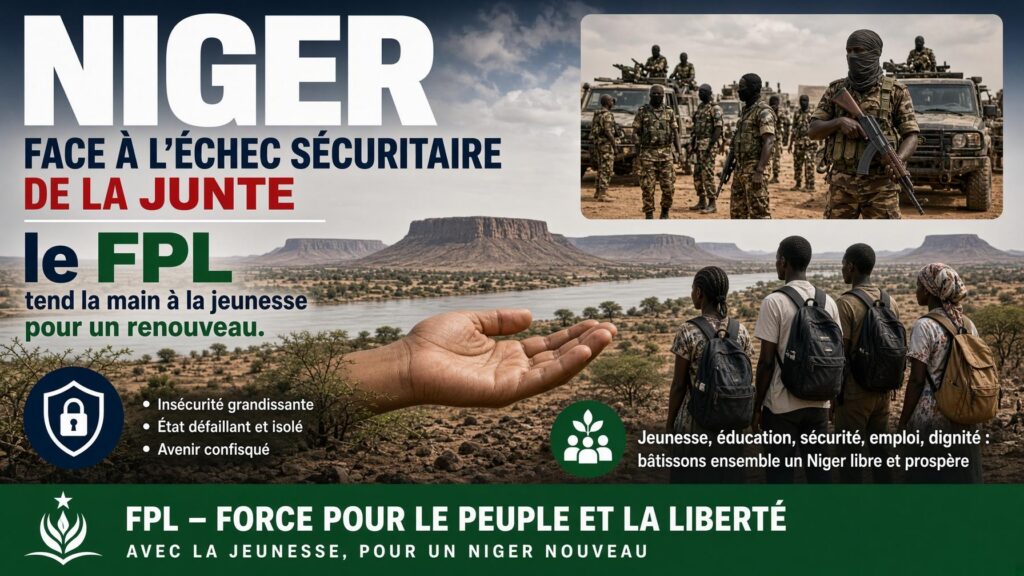
The video spread across social media in a matter of days, voiced in Arabic and several local languages, and it landed like a stone in still water. The Popular Front for Justice (FPL) had already made its name as an armed movement, but this message was aimed squarely at a different audience: Niger’s youth. As the military regime in Niamey struggles to shield civilians from a steadily worsening security crisis, the appeal has triggered a wave of debate, cautious hope, and hard questions about what happens if the younger generation actually answers the call.
The fallout of a direct appeal to the nation’s youth
The FPL’s statement was blunt and carefully worded. The movement insisted it has no quarrel with the people of Niger, only with the regime in power, and it issued what it described as a special invitation to young people to join its ranks on the front line. Within hours, the message was being shared, dissected, and disputed in group chats, on radio call-in shows, and in neighbourhood conversations from the capital to the border regions.
The reaction has been far from uniform. Some see a calculated recruitment drive by an armed group. Others, particularly among young people in areas hit hardest by violence, describe it as the first time in years that someone has spoken directly to their frustration. The debate itself has become a political event, forcing families and communities to confront a question they had largely avoided: if the state cannot protect you, who will?
A multilingual message that bypasses official channels
By delivering the appeal in Arabic alongside several local languages, the FPL signalled that it wanted to be heard well beyond any single region or ethnic group. In a country as vast and diverse as Niger, that choice matters. It suggests an attempt to build a broad, national audience rather than a narrow base, and it allows the message to reach communities living closest to the violence.
Equally notable is the method. The movement bypassed state media entirely, using digital platforms to speak directly to young people who feel shut out of official discourse. For a generation that consumes news primarily through phones and social networks, the approach felt immediate and personal, even to those who reject the FPL’s armed struggle.
Why the appeal resonates: security, jobs, and a sense of abandonment
The FPL’s timing is no accident. Despite the junta’s promises to restore order, armed attacks and chronic insecurity continue to batter civilian populations, especially in rural and border zones. Three grievances in particular keep surfacing in conversations across the country:
- A deteriorating security climate — armed threats persist, and communities see little evidence that the promised peace is arriving.
- An institutional and economic vacuum — young people face shrinking opportunities and almost no support as daily life grows harder.
- A deepening feeling of abandonment — many communities no longer believe the state will ever deliver protection where they live.
For a large segment of Niger’s youth, the FPL’s invitation is being read less as a call to arms and more as an opening to take control of a future that has been slipping away. Whether or not they trust the messenger, the message has forced a reckoning.
Voices from the ground: hope, anger, and unanswered questions
On the ground, the initiative is generating growing interest among those demanding a political and security alternative. “The current situation cannot go on. We need real solutions to protect our families and restore justice,” said one young community activist, reflecting a sentiment echoed by many of his peers. For these young people, the FPL’s move looks like a legitimate channel for engagement at a time when the government appears paralysed.
But the enthusiasm is tempered. Some worry that youth mobilisation could deepen divisions or drag civilians further into a conflict they did not choose. Others ask what guarantees exist for those who join, and what kind of Niger would emerge afterwards. The FPL has placed young people at the centre of its project, betting on the country’s vital energy to drive change. The coming months will show whether that bet pays off, or whether the debate it has sparked will fade as quickly as it flared. Either way, the question of Niger’s youth — their anger, their patience, and their choices — is now impossible to ignore.