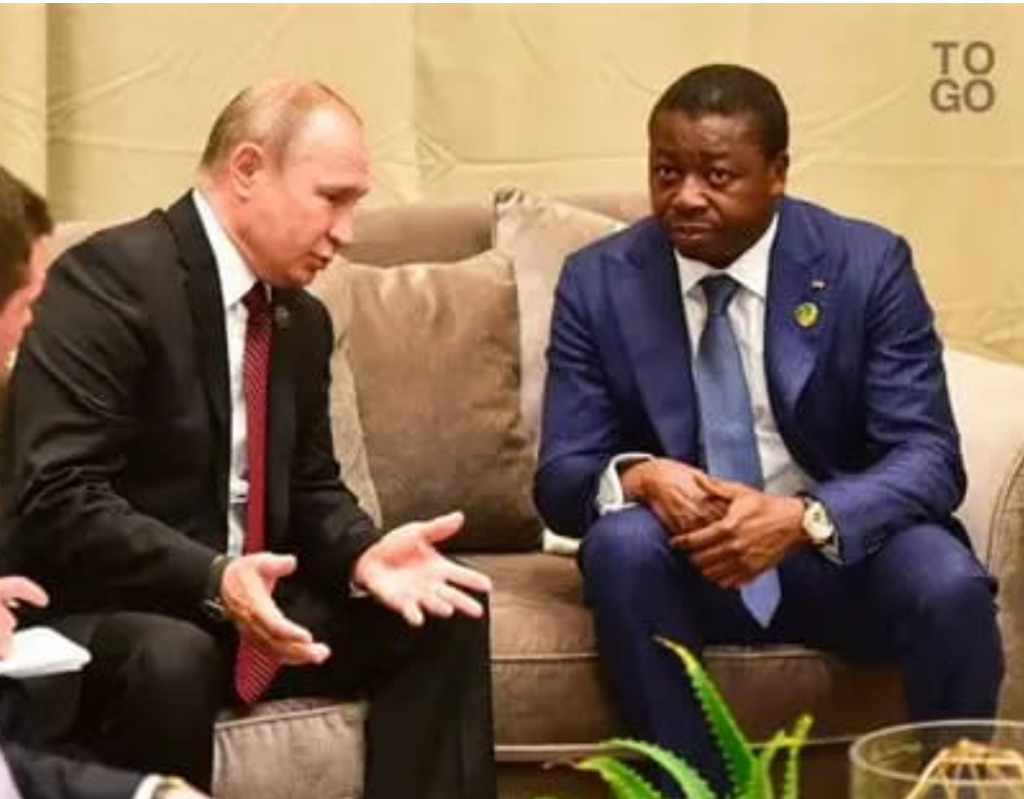
While Russia’s military operations in the countries of the Alliance of Sahel States face continuous, bloody setbacks, Moscow is strategically reorienting a portion of its efforts towards the Gulf of Guinea. By welcoming vessels from Russia’s so-called ‘ghost fleet’ and permitting the proliferation of the Kremlin’s cultural and religious influence, Faure Gnassingbé’s autocratic regime is transforming Togo into a critical logistical and political hub for West Africa.
Lomé: a new sanctuary for sanctioned vessels
The autonomous port of Lomé, the sole deep-water port in the sub-region, is evolving beyond a mere commercial crossroads. It is rapidly becoming an essential link in Moscow’s strategy for war logistics and evasion of international sanctions. The recent call of the cargo ship Britnev, linked to Russian interests, in Lomé, followed by the closely monitored maneuvers of the Baltic Leader off West African coasts, has raised alarms among maritime and geopolitical observers. These vessels, often registered under flags of convenience or associated with the Kremlin’s shadowy fleet, transport strategic equipment, raw minerals, and energy resources, effectively bypassing Western radars and embargoes. By opening its maritime infrastructure to internationally monitored ships, the Togolese government provides Russia with a direct gateway to the West African hinterland.
The shadow of clandestine agreements and the Sahel’s plight
This naval diplomacy is far from coincidental; it arrives at a critical juncture for Russian influence across West Africa. In Mali, Burkina Faso, and Niger, nations united under the Alliance of Sahel States, the presence of the paramilitary group Wagner – now rebranded as Africa Corps – is facing a strategic debacle. Far from stemming the jihadist threat, Russian mercenaries are enduring a series of painful defeats, marked by deadly ambushes and colossal material losses. The failure of Russia’s security promises in the Sahel compels the Kremlin to seek more secure bypass and resupply routes. What Russia seeks in Lomé is a stable maritime facade, safely beyond the Sahelian conflict zones, enabling smoother provisioning for military regimes while facilitating clandestine contracts. These agreements, reportedly negotiated in utmost state secrecy between Moscow and the Gnassingbé clan, are understood to cover mining concessions, untraceable arms deals, and high-level security guarantees, impacting regional dynamics and Mali security concerns.
The Gnassingbé regime: authoritarianism as an open door
Togo’s appeal to Russian diplomacy stems from its ideal conditions for Kremlin influence operations: a hyper-centralized power structure, a completely stifled democracy, and a suppressed opposition. Having governed since 2005, succeeding his father who ruled for nearly four decades, Faure Gnassingbé recently solidified his institutional control. A constitutional revision, adopted through a process widely criticized by civil society, transitioned Togo from a presidential to a parliamentary system, effectively guaranteeing the president almost unlimited power under a new title. For a regime facing internal dissent and consistently flagged by human rights organizations for systematic repression, banning protests, and arresting opponents, the partnership with Russia represents a crucial diplomatic lifeline. Unlike traditional partners or international financial institutions, Moscow imposes no conditions related to human rights, budgetary transparency, or the organization of free elections.
Soft power, faith, and propaganda: a cultural encirclement strategy
The Russian offensive in Togo extends beyond cargo ships and confidential financial transactions. It manifests as an aggressive soft power campaign designed to shape public opinion and firmly anchor Moscow’s presence. This strategy primarily relies on a robust associative and cultural push, marked by the proliferation of cultural centers, exhibitions, and Russian language courses that serve as recruitment showcases and conduits for anti-Western propaganda. Complementing this is a targeted religious expansion, where the Patriarchal Exarchate of Africa of the Russian Orthodox Church establishes its structures throughout the country, combining social action with proselytism to supplant traditional religious influences. Finally, this penetration is bolstered by an intense information war, involving the funding of local NGOs and social media channels to disseminate a pro-Kremlin narrative. This dynamic allows the ruling power to instrumentalize the sovereignist sentiment among youth, diverting attention from domestic economic and political failures.
A perilous gamble for regional stability
By engaging with the Kremlin, Faure Gnassingbé is playing a dangerous game that exposes Togo to multiple destabilizations. The nation risks growing diplomatic isolation and a continuous deterioration of its relations with long-standing international partners. On the security front, by becoming the logistical heart for the Alliance of Sahel States’ regimes, Togo directly risks attracting the very terrorist threat it seeks to avoid on its northern borders, a concern that echoes regional stability issues impacting West Africa Mali. Furthermore, this alliance exacerbates the internal social crisis, as corruption linked to clandestine contracts enriches a restricted elite while the general population endures worsening living conditions. The Lomé-Moscow axis thus illustrates a new African geopolitical reality, forged by an alliance of interests between a local autocrat determined to consolidate his dynasty and a foreign power seeking conduits of influence to mask its military shortcomings.